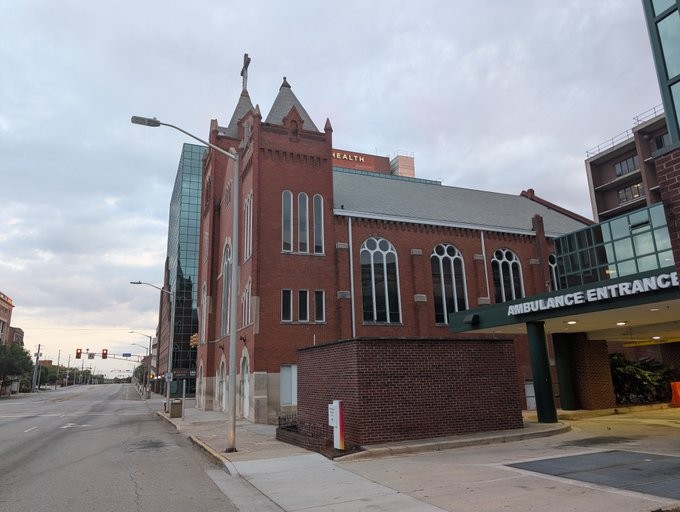
Bethel A.M.E. Church ca 1921
Bethel A.M.E. Church, ca. 1921 — Columbia, South Carolina. Located at 1528 Sumter Street at the corner of Taylor Street, the historic Bethel A.M.E. Church is one of Columbia’s most important landmarks associated with African American religious and civic history. The present sanctuary was constructed in 1921 for a congregation organized in 1866, making Bethel one of the earliest independent African American congregations established in Columbia following the Civil War. Designed by John Anderson Lankford, one of the first registered African American architects in the United States and later the official architect of the African Methodist Episcopal Church, the building is a monumental expression of Romanesque Revival architecture. Its rectangular brick mass is dominated by a gabled roof and two asymmetrical towers, with the taller north tower rising in three stages above the basement. Round-arched openings, corbelled brickwork, stained glass, a tripartite belfry, and tall pyramidal tower roofs give the façade a richly textured and imposing character.
Beyond its architectural importance, Bethel A.M.E. Church served for generations as a major center of Columbia’s African American community. Lankford conceived his churches as community institutions as well as houses of worship, incorporating spaces that could accommodate social and civic activities. During the Civil Rights era, Bethel became a gathering place for meetings, rallies, and organizing, further strengthening its importance in the history of Columbia’s African American community. The congregation remained at the Sumter Street sanctuary until 1995, when it relocated to the former Shandon Baptist Church on Woodrow Street. The historic 1921 building was subsequently recognized for its architectural and historical significance through listing in the National Register of Historic Places in 1982. Its monumental Romanesque Revival design, association with Lankford, and connection to more than a century of African American religious and community life make Bethel A.M.E. Church one of Columbia’s most significant historic resources.