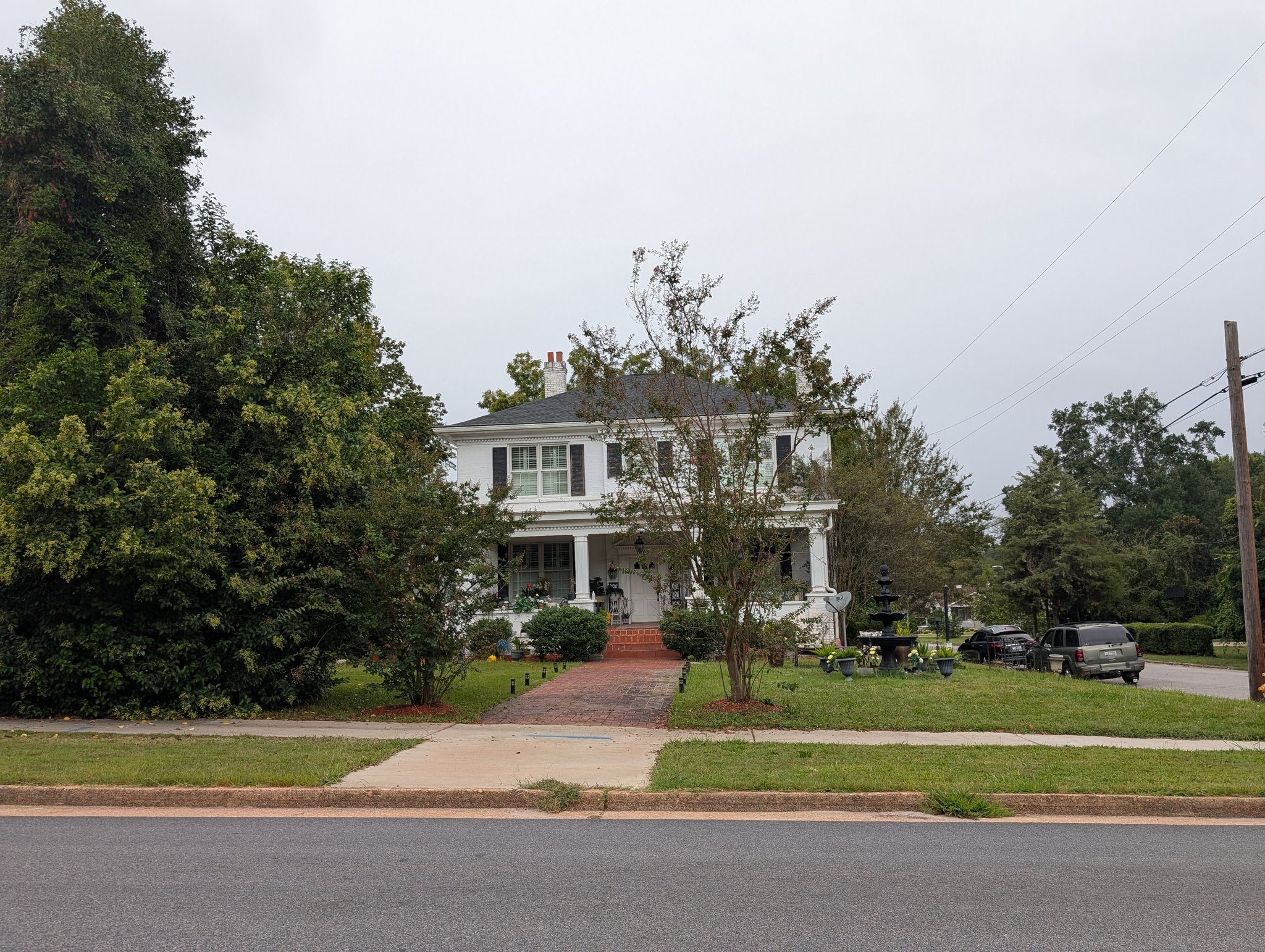
Youman House in Newberry
The Youman House in Newberry stands as a distinguished example of early 20th-century Southern residential architecture, reflecting both the craftsmanship of its builders and the refined tastes of its original occupants. Nestled within a historic residential neighborhood, the house conveys balance, elegance, and a welcoming presence, embodying the architectural character and domestic ideals of Newberry’s prominent families during a period of growth and civic pride.
The two-story frame structure is defined by a front-facing gable and gently pitched roof, giving the façade visual interest and vertical emphasis. A broad front porch stretches across the entrance, supported by turned wooden posts and accented with carefully crafted trim. This porch functions as both a shaded retreat and a social threshold, exemplifying the Southern tradition of integrating indoor and outdoor living. Tall, narrow sash windows punctuate the exterior walls, admitting natural light while establishing rhythm and proportion across the façade.
Ornamental detailing on the Youman House is applied with restraint and elegance. Bracketed eaves, subtle gable trim, and finely executed porch elements enhance the structure’s aesthetic without overwhelming its balanced composition. Inside, high ceilings, spacious rooms, and polished wood finishes create a comfortable and gracious environment suited to both family life and social entertaining, reflecting the lifestyle and social stature of the Youman family.
Historically, the house is associated with the Youman family, whose presence and contributions were woven into Newberry’s civic and social life. The residence stands not only as a domestic dwelling but also as a witness to the town’s growth and evolving character, linking personal histories to the broader architectural and cultural heritage of Newberry.
Today, the Youman House endures as a valued component of Newberry’s historic landscape. Its porch, gables, and carefully executed details continue to convey the skill, taste, and aspirations of its builders, offering a tangible connection to the town’s streetscape and the generations who shaped its social and architectural identity.