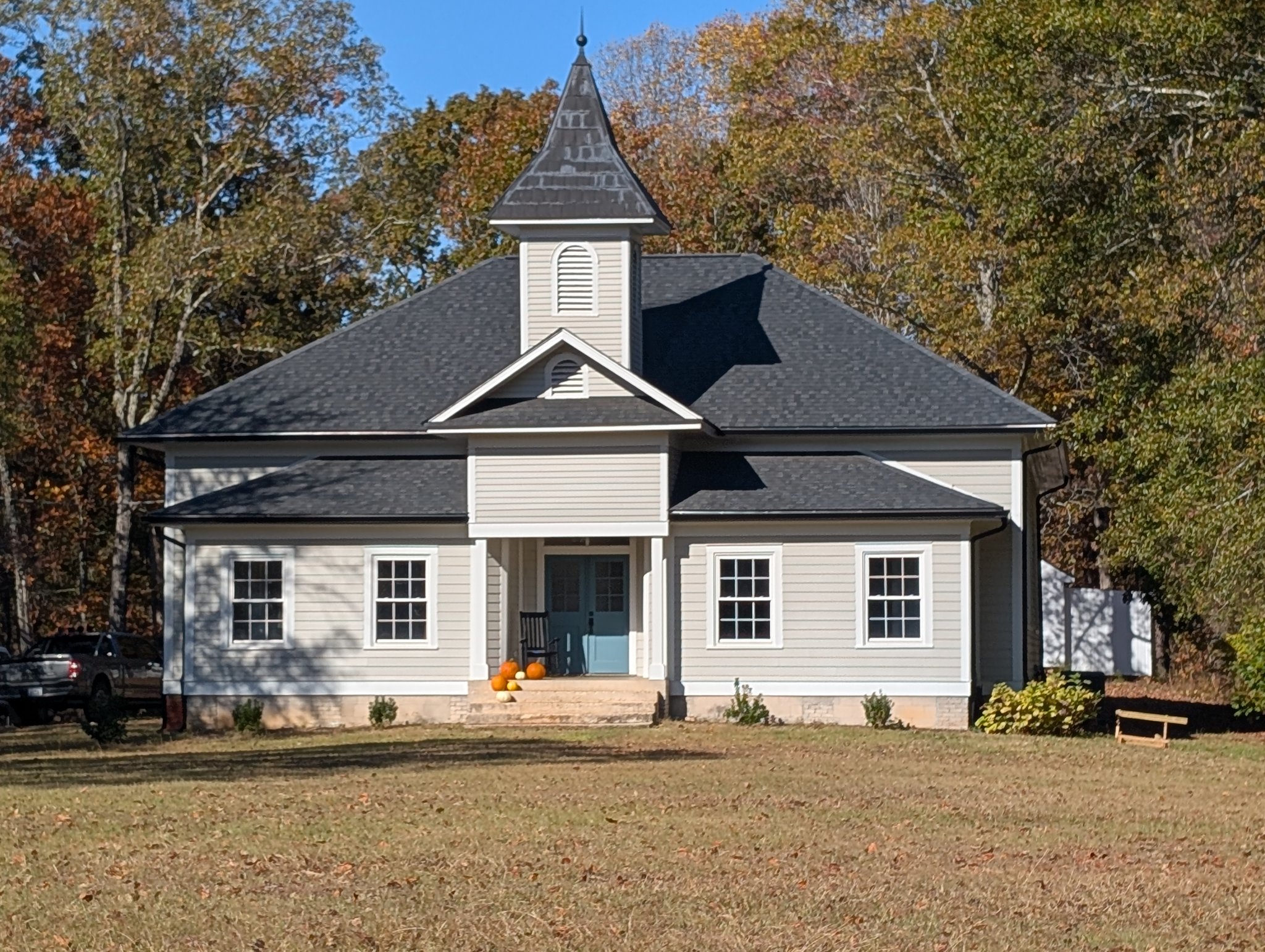
Wolf Creek School in Pickens
The school is documented as in operation at least by 1894, with B. A. Allgood listed as teacher that year — and later principal during the 1899–1901 period. At that time, Pickens County featured a patchwork of small school districts, each serving children in scattered rural communities. Wolf Creek School was one such district schoolhouse in this landscape.
By 1947, the school was described in a survey (done as a thesis for Furman University) as a three-teacher, seven-grade institution serving about 54 pupils. It had modern amenities for its time: a hard-surfaced road, running water, electric lights, wire-covered windows. In the primary room the teacher used a “science center” and a “reading center” and the playground offered space for recreation.
These details are significant because they show how even a small rural school was embracing more advanced pedagogy and infrastructure by the mid-20th century. The school thus served not only as a location for basic literacy and arithmetic, but also as a community hub—reflecting social, recreational, and civic facets in a rural district.
In the broader context of Pickens County, Wolf Creek School was part of a network of numerous small schoolhouses prior to school consolidation. As one local history account notes: “before they consolidated, they had 52 individual school districts scattered throughout the county.”
Wolf Creek is listed among the many sites of historical interest in the county’s “Cultural Resources” element of the county plan. Its survival (even in altered form) helps to preserve the narrative of rural schooling before the era of large regional school complexes.
The school appears in use until at least 1952 (historic photographs show it then) and afterward underwent transformations as school consolidation and modernization reshaped rural education.
One more recent local reflection notes that the Wolf Creek schoolhouse “someone just renovated it into a house” – a sign of adaptive reuse of historic school buildings in rural areas.
While the building’s original educational purpose is no longer active, its legacy is important: it illustrates how communities invested in childhood education, how rural schools became local landmarks, and how changes in infrastructure, transportation and policy eventually rendered many of these one- and two-room rural schools obsolete.
The Wolf Creek School tells the story of how education, place and community intersected in rural South Carolina. It is not simply a building, but a testament to the value placed on educating children in remote areas; to community effort; to the changes in infrastructure (roads, electricity, water) and pedagogy; and to the larger transitions in American schooling in the 20th century.
If you’re ever exploring Pickens County’s history, driving by the Allgood Bridge Road site offers a moment of reflection: here was a place where generations of children gathered, teachers worked to broaden horizons, and a community anchored one of its institutions in hopeful continuity. The story of Wolf Creek School is a microcosm of that rural American educational heritage.