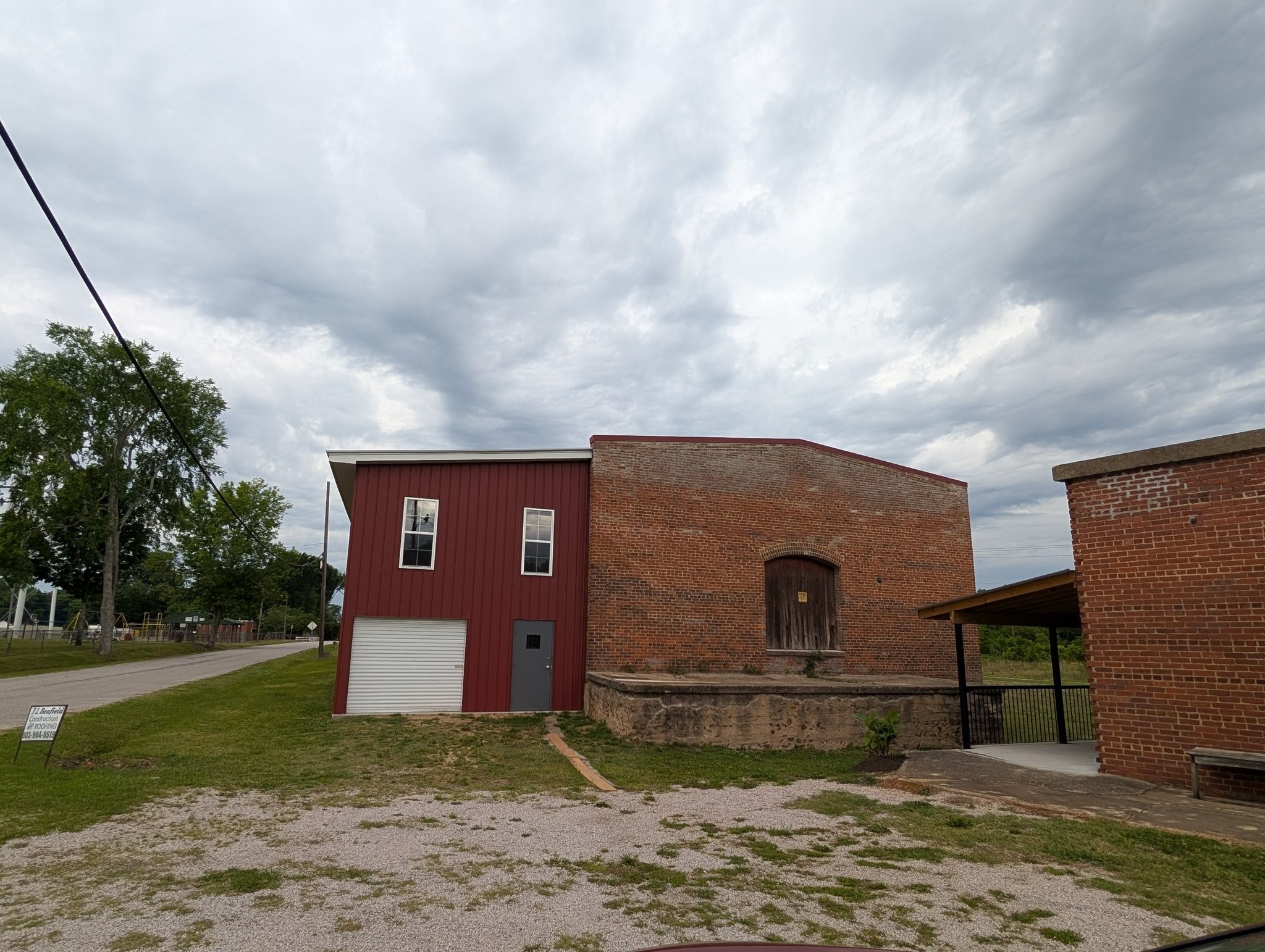
William L Hill Cotton Gin ca 1925
Constructed around 1925, the William L. Hill Cotton Gin represents an important link in York County’s early twentieth-century agricultural economy, reflecting the continued centrality of cotton production to the rural South during the interwar period. Established during a time when mechanized processing had become essential to farm efficiency, the gin served as a critical facility where locally grown cotton was transformed into a market-ready commodity, supporting both small farmers and larger agricultural operations throughout the surrounding countryside.
Functionally, the cotton gin operated as a seasonal industrial hub, drawing harvests from nearby fields for processing. Inside, mechanical gin stands separated cotton fibers from seed, dramatically increasing productivity compared to earlier manual methods. The associated seed handling and storage areas allowed for the reuse or redistribution of seed, while bale press systems compressed cleaned cotton into transportable forms for shipment to regional textile markets. The layout of the operation would have been organized for workflow efficiency, with receiving areas, processing zones, and storage spaces arranged to support continuous seasonal throughput.
Architecturally, the structure reflects the utilitarian design principles typical of agricultural-industrial buildings from the early twentieth century. Built primarily for function rather than ornamentation, it likely featured simple wood or metal framing, weather-resistant siding, and large open interior bays to accommodate machinery and raw material movement. Ventilation openings and wide access points would have supported both safety and efficiency, while the overall form remained straightforward and purpose-driven.
Beyond its operational role, the William L. Hill Cotton Gin stands as a testament to the agricultural heritage of York County and the enduring importance of cotton in shaping the region’s economy and landscape. It reflects a period when local gins served as essential community infrastructure, connecting rural producers to broader regional and global markets. Today, it remains a tangible reminder of the labor, technology, and agricultural traditions that defined the early twentieth-century rural South.