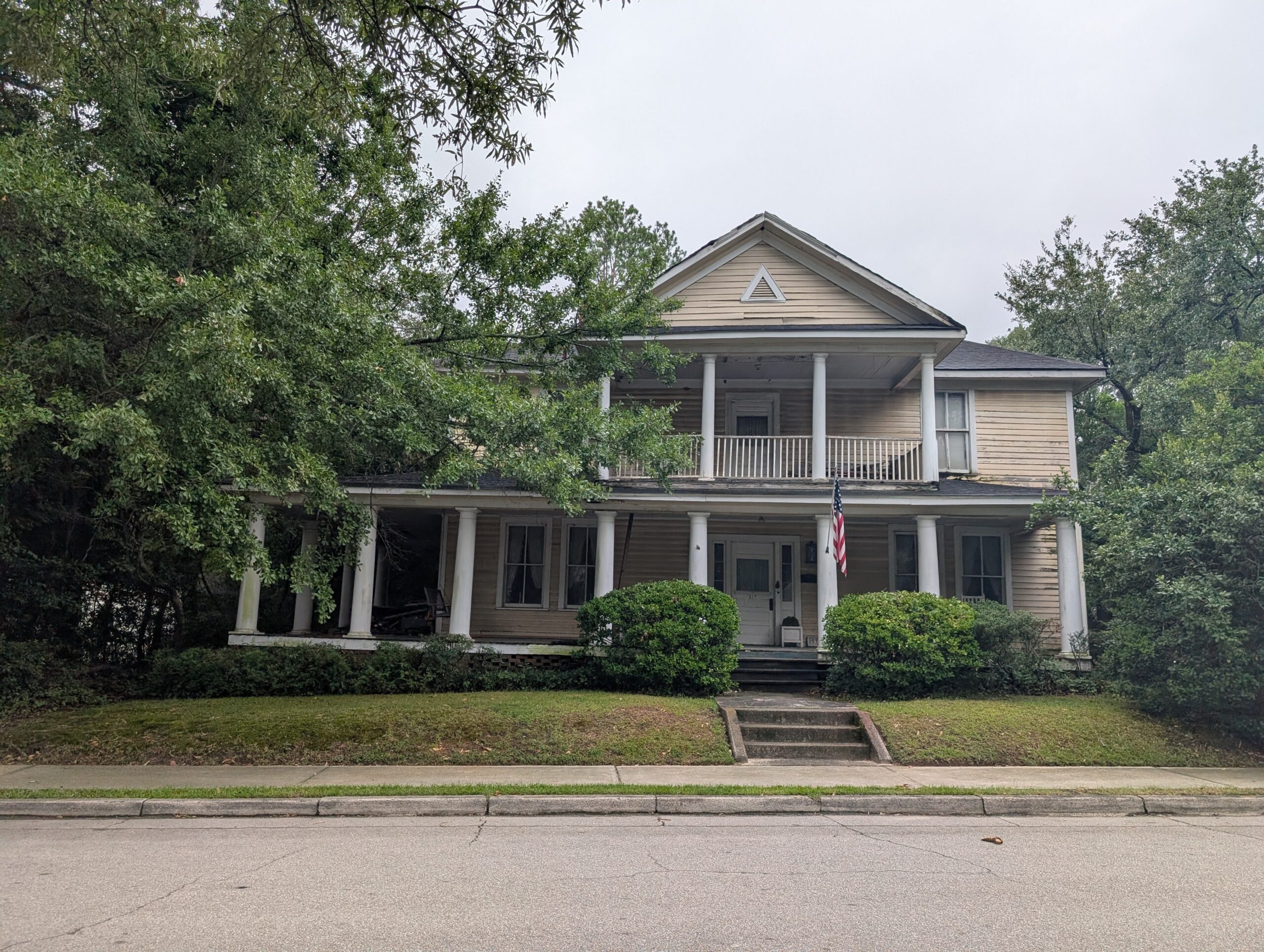
William J. Cayce house ca 1917
Constructed around 1917, the William J. Cayce House is one of the most significant surviving residences associated with the early development of the City of Cayce. Built during the period when the community was emerging as an important industrial and railroad center along the Congaree River, the house reflects the prosperity and civic pride of the town’s early twentieth-century leaders. The residence is closely associated with William Joseph Cayce, a prominent businessman and community figure whose name became permanently linked with the city’s identity and growth.
The two-story frame residence represents the architectural tastes of the early 1900s, incorporating elements of the Colonial Revival and traditional Southern residential styles that became popular throughout South Carolina during the period. The house features a symmetrical façade, a prominent central entrance, a broad front porch supported by substantial columns, and carefully crafted wood detailing characteristic of early twentieth-century construction. The balanced proportions, generous windows, and spacious interior arrangement reflect the desire for comfort, refinement, and permanence that shaped many residences built by successful families during this era.
The home was constructed during a transformative period in the history of Cayce. Originally known as the town of Cayce after its incorporation in 1914, the community developed rapidly because of its location near major railroad lines, nearby textile industries, and the growing commercial influence of neighboring Columbia. Houses such as the William J. Cayce House represented the arrival of a new generation of civic and business leaders who helped establish the foundations of the modern city.
William J. Cayce played an important role in the early identity of the community that bears his family name. His residence served as both a private family home and a symbol of local success during a period when Cayce was evolving from a railroad settlement into a recognized municipality. The house reflects the connection between individual achievement and community development that characterized many South Carolina towns during the early twentieth century.
Architecturally, the William J. Cayce House provides an important example of the transition from the ornate Victorian traditions of the nineteenth century to the more restrained and symmetrical designs favored in the early twentieth century. Its craftsmanship, scale, and setting illustrate the changing lifestyle of South Carolina’s emerging middle and upper classes during the decades following industrial expansion.
Today, the William J. Cayce House remains an important landmark in Cayce, preserving a tangible connection to the city’s formative years. Through its architecture and association with one of the community’s earliest leaders, the residence continues to represent the ambition, growth, and civic spirit that shaped the development of Cayce during the early 1900s.