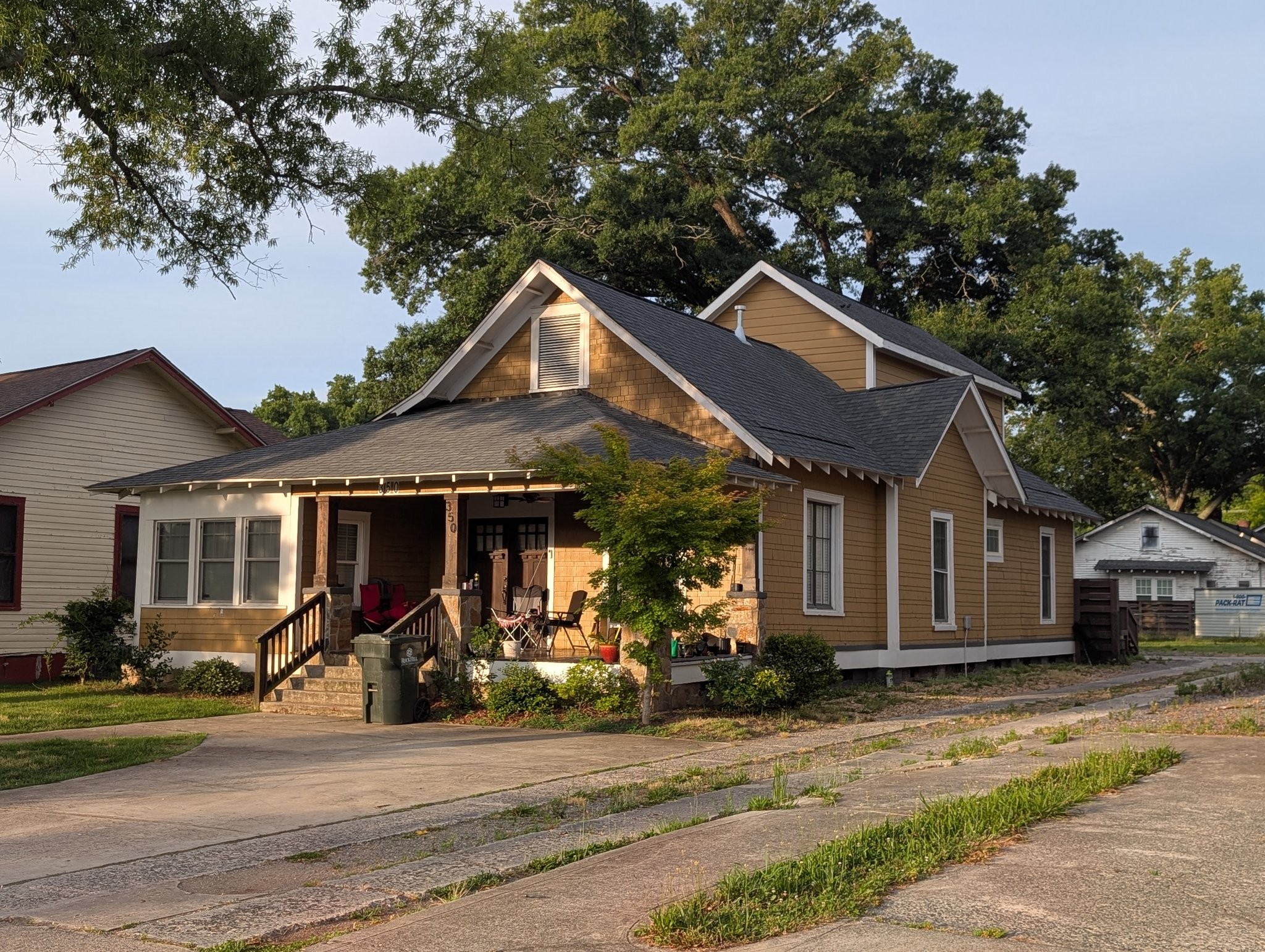
W.O. Barber house ca 1920
Constructed around 1920, the W.O. Barber House represents the continued residential growth that accompanied Rock Hill’s emergence as one of the leading industrial and commercial centers of the South Carolina Piedmont. During the early decades of the twentieth century, the city experienced substantial expansion fueled by the success of its textile mills, railroad connections, and thriving business community. New residential districts developed to accommodate a growing population, and houses such as the Barber House became important components of the city’s evolving suburban landscape.
Architecturally, the residence reflects the influence of the Craftsman movement, which dominated American residential design during the 1910s and 1920s. Emphasizing simplicity, quality workmanship, and harmony with its surroundings, Craftsman-inspired homes typically featured broad rooflines, deep porches, exposed structural elements, and carefully crafted details. The W.O. Barber House embodies these design principles while also reflecting local building traditions that contributed to the distinctive character of Rock Hill’s historic neighborhoods.
The house is associated with a period when homeownership increasingly symbolized stability and economic achievement for the city’s growing middle class. As Rock Hill expanded, residences such as this one provided comfortable and modern living spaces for families connected to the community’s commercial, industrial, and civic life. The development of these neighborhoods helped establish the residential character that continues to define many areas of the city today.
The W.O. Barber House remains a valuable surviving example of early twentieth-century domestic architecture in Rock Hill. Its historical associations and architectural character illustrate the optimism and prosperity that marked the city’s development during the post–World War I era. As part of the community’s historic residential fabric, the house contributes to an understanding of the people, neighborhoods, and architectural traditions that shaped Rock Hill during one of its most transformative periods of growth.