University of South Carolina Horseshoe — Columbia, South Carolina
The Historic Horseshoe of the University of South Carolina is one of Columbia’s most recognizable historic landscapes and one of the most important surviving academic campuses in the South. Developed from the original South Carolina College established in 1801, the Horseshoe represents more than two centuries of educational, architectural, political, military and social history. The original campus was organized around a formal U-shaped arrangement of buildings and green space, a plan that remains remarkably legible today. The campus was placed on the National Register of Historic Places in 1970, recognizing its exceptional importance to the history of South Carolina and American higher education.
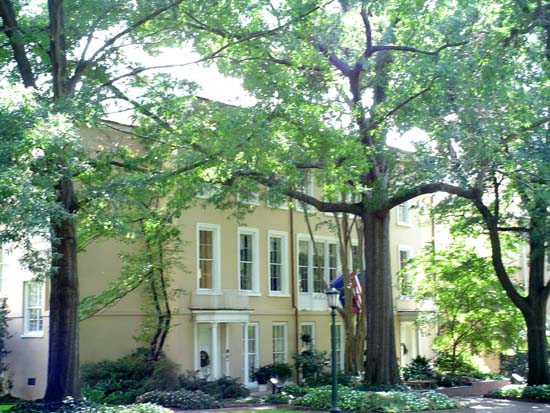
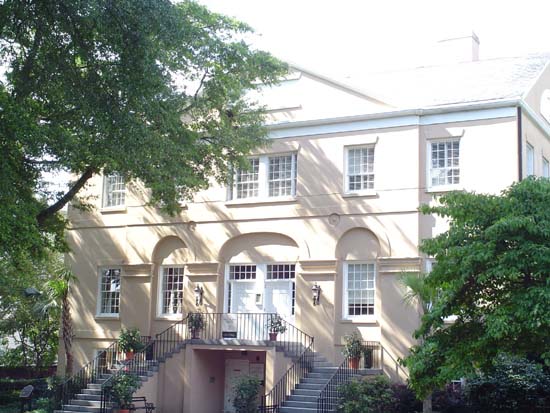
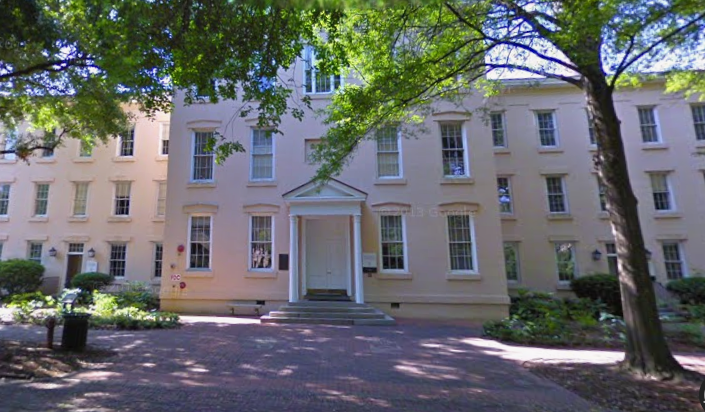
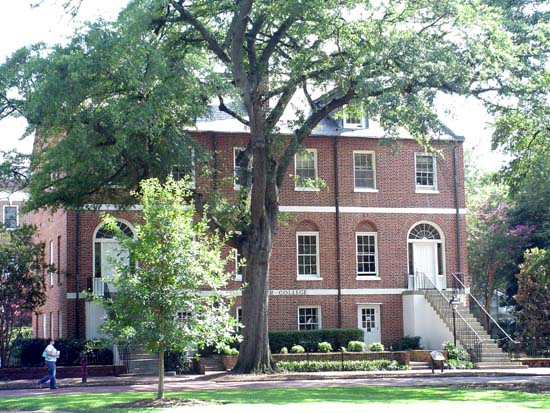
At the heart of the complex is Rutledge College, completed in 1805 and regarded as the original campus building. Designed by Richard Clark and associated with Robert Mills, it established the architectural vocabulary and spatial organization that would define the Horseshoe. Over the following decades, additional residential and academic buildings were constructed around the central green, including McCutchen House (1813), Elliott College (1837), Lieber College (1837), Pinckney College (1837), Harper College (1848), Legare College (1848), and the South Caroliniana Library (1840). Together these buildings created an architectural ensemble rather than a collection of unrelated structures, with their brick construction, restrained classical detailing, symmetrical facades and carefully arranged grounds producing the distinctive appearance of the Old Campus.
The Horseshoe Wall, constructed in 1835–1836, completed much of the historic enclosure. Built of solid brick under the direction of carpenter Thomas H. Wade and bricklayer Thomas R. Davis, the wall originally stood approximately 6 feet 9 inches high and surrounded the campus along Sumter, Greene, Bull and Pendleton Streets. Although initially intended partly to keep students away from Columbia’s taverns after hours, the wall acquired a far more dramatic role during the Civil War. When Columbia burned on February 17–18, 1865, the brick enclosure helped shield portions of the college grounds from the surrounding flames. The wall has subsequently been altered, with openings changed and portions raised, lowered, opened and closed, but it remains one of the defining features of the Horseshoe.
The campus also preserves important evidence of the university’s complicated relationship with slavery. Enslaved laborers constructed and maintained many of the historic buildings, and enslaved workers were hired out to perform daily tasks at the college. The surviving Slave Quarters, dating from the 1840s, is a particularly significant reminder of this history. The university now formally interprets the role of enslaved people in the construction and operation of the early college through historical markers and other commemorative efforts.
The Horseshoe was also an important setting during Reconstruction. From 1873 to 1877, when the university was briefly desegregated, buildings including Rutledge and Legare colleges became associated with the education and residence of African American students. T. McCants Stewart, an important Reconstruction-era figure, became the first African American graduate of the university. The campus therefore embodies not only the antebellum history of South Carolina College but also one of the earliest chapters in the history of integrated higher education in the state.
Other structures add layers to the architectural and institutional history of the site. Longstreet Theatre, constructed in 1855, was originally intended as a chapel but was never successfully used for that purpose because of poor acoustics. During the Civil War it served as a hospital and morgue and later as an arsenal, armory, science hall and gymnasium before its restoration and conversion into a theater. The Old Observatory, built in 1852, reflects the college’s nineteenth-century interest in science and housed a seven-inch telescope used in instruction before the Civil War.
The Horseshoe continued to evolve during the twentieth century without losing its historic identity. McKissick Museum, completed in 1940 to replace the former president’s house as the campus library, represents the principal twentieth-century addition within the historic Horseshoe. The building was later converted into a museum and remains a major architectural and cultural landmark on the campus. The university’s extensive restoration program of the 1970s helped preserve the nineteenth-century buildings and established the Horseshoe as both an active university environment and a carefully protected historic landscape.