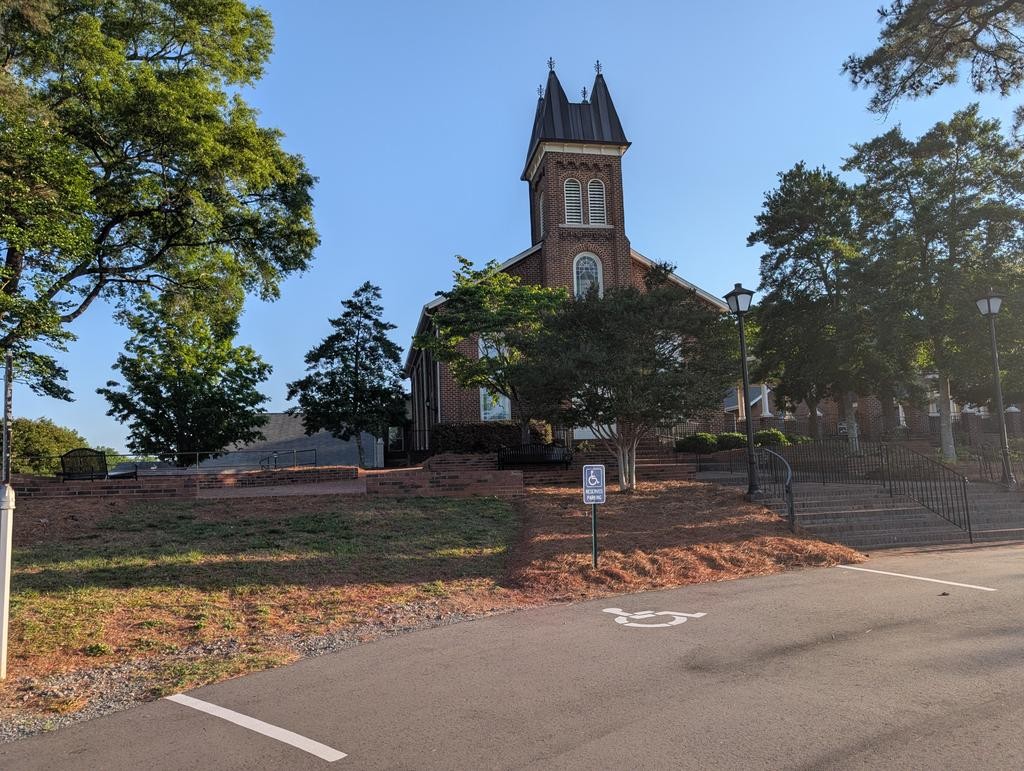
United Presbyterian Church Complex ca 1881
The United Presbyterian Church Complex, constructed circa 1881 in Fort Mill, stands as one of the community’s most historically significant ecclesiastical sites, reflecting the deep religious foundations and post–Reconstruction growth of the town. Established during a period when Fort Mill was transitioning from a rural agrarian settlement into a more structured and connected village, the church complex embodies the spiritual, social, and civic role that Presbyterian congregations played in shaping the cultural identity of York County.
Formed through the consolidation and evolution of earlier Presbyterian congregations in the area, the United Presbyterian Church became a focal point for worship, education, and community organization. Churches of this era in Fort Mill often served far beyond their religious function, doubling as meeting spaces, schools, and gathering places for civic discussions, charitable efforts, and community events. The complex therefore represents not only a place of worship but also a cornerstone of local social infrastructure during the late nineteenth century.
Architecturally, the church complex reflects the restrained yet dignified ecclesiastical design typical of rural and small-town Presbyterian churches in the American South during the late 1800s. The main sanctuary likely features a simple rectangular plan, wood-frame or brick construction, tall lancet or sash windows, and a prominent front-gabled roof emphasizing verticality and order. Interior spaces would have been designed with an emphasis on clear sightlines to the pulpit, reflecting Presbyterian liturgical traditions centered on preaching and scripture.
The construction of the complex in the early 1880s coincided with a broader period of renewal and stabilization in Fort Mill following the Civil War. As textile manufacturing and rail access began to reshape the region’s economy, institutions like the United Presbyterian Church provided continuity, moral guidance, and social cohesion for a growing population. The church became an anchor for families who were navigating the shift from an agrarian society to an increasingly industrial one.
Over time, the United Presbyterian Church Complex has remained a significant landmark in Fort Mill’s religious and architectural history. Its presence reflects the enduring role of faith-based institutions in shaping the town’s identity, preserving community memory, and fostering social unity across generations. Today, it stands as a testament to the spiritual heritage and civic resilience of Fort Mill’s nineteenth-century residents.