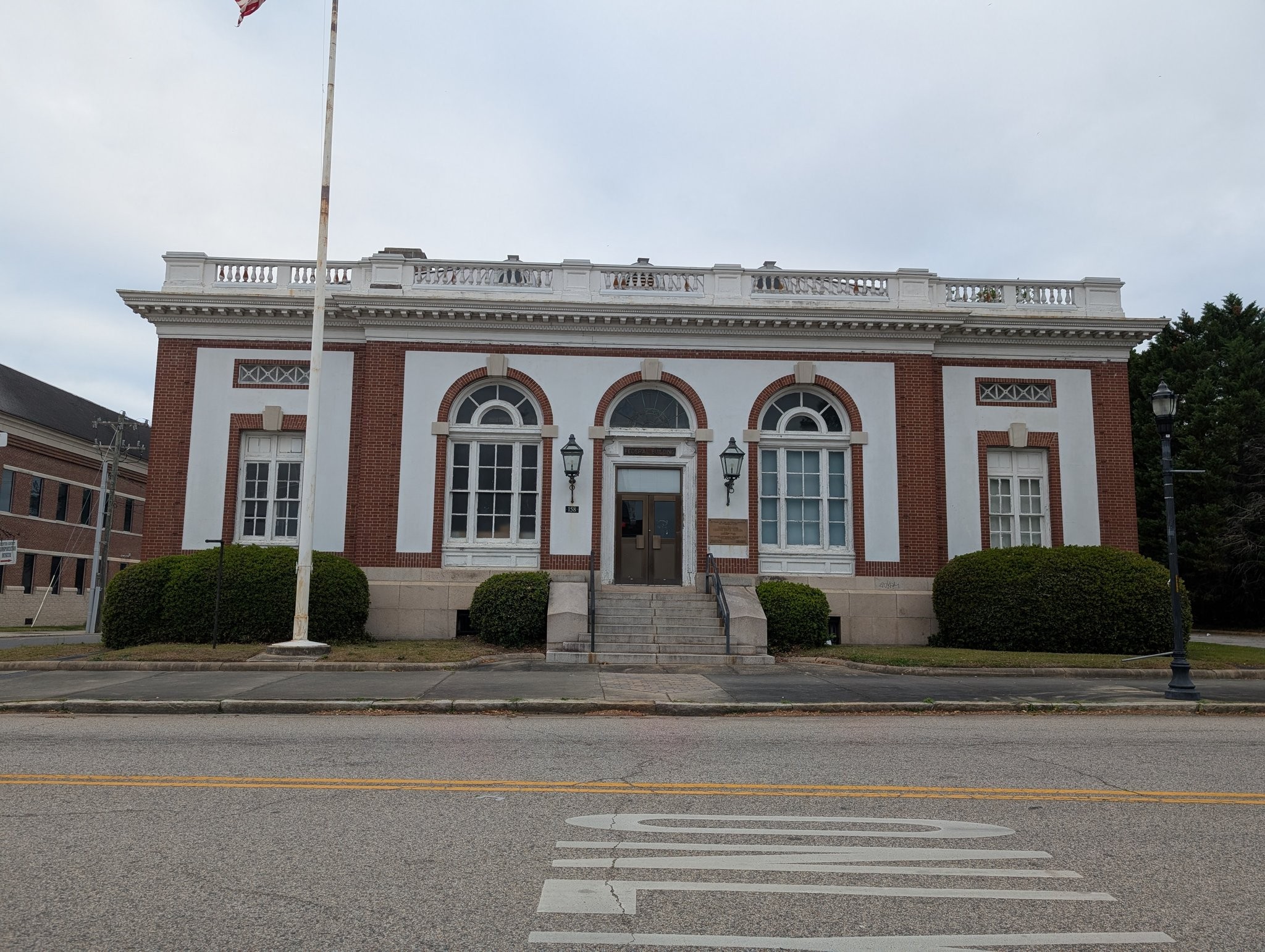
U.S. Post Office (ca. 1908)
U.S. Post Office (ca. 1908) stands as a dignified symbol of early 20th-century federal presence in Chester, reflecting a period when small Southern towns were increasingly integrated into a modern national communications network. Constructed during an era of civic expansion and institutional confidence, the building embodies both governmental authority and the architectural refinement typical of early federal facilities.
Stylistically, the structure is commonly associated with Beaux-Arts and Classical Revival influences, which were widely used for post offices across the United States in the early 1900s. The design emphasizes symmetry, proportion, and permanence, presenting a balanced façade anchored by a central entrance that conveys formality and accessibility. The building is typically constructed of stone or brick, materials chosen to communicate stability and federal legitimacy.
The exterior often features restrained classical detailing such as pilasters, cornice lines, or a modest entablature reflecting the influence of ancient Greek and Roman architecture interpreted through a modern civic lens. Windows are regularly spaced and uniformly proportioned, reinforcing the building’s orderly composition. A slightly elevated foundation or steps leading to the entrance further enhance its presence within the streetscape.
Inside, the post office would have been organized for efficient public service, with a central lobby designed for customer transactions, mail sorting areas, and administrative offices arranged behind or above. High ceilings, durable finishes, and simple decorative moldings create a functional yet respectable interior environment suited to daily civic activity.
As a cornerstone of early 20th-century infrastructure, the Chester post office played a vital role in connecting the community to the broader region and nation through mail service, telegraph communication, and federal administration. Its enduring presence reflects both the growth of Chester during the early 1900s and the broader transformation of American towns into interconnected civic hubs during this period of modernization.