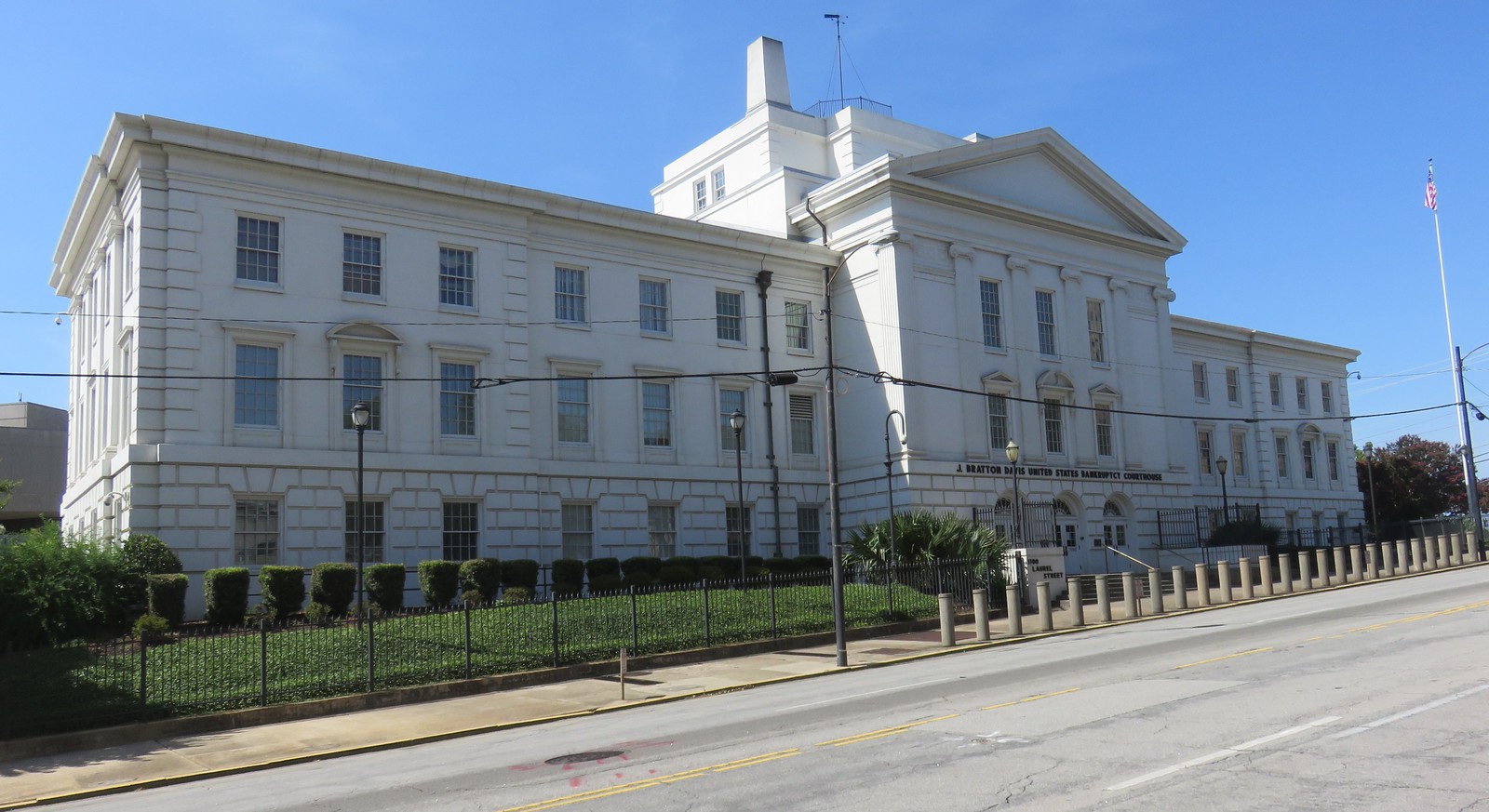
U.S. Courthouse ca 1936 in Columbia
The U.S. Courthouse, now known as the J. Bratton Davis U.S. Bankruptcy Courthouse, at 1100 Laurel Street in Columbia, is a distinguished example of Depression-era federal architecture and an important landmark in the city’s governmental history. Constructed in 1936, the building was commissioned to replace Columbia’s earlier federal building and courthouse at 1737 Main Street, which had been constructed in the 1870s and is now Columbia City Hall. The new courthouse reflected the federal government’s expanding presence in Columbia and its commitment during the New Deal era to providing modern, permanent facilities for the federal courts and agencies.
The project was authorized in 1932, when the Postmaster General and Secretary of the Treasury approved $550,000 for a new courthouse and office building, later reducing the appropriation to $500,000. The federal government and the City of Columbia arranged an exchange of properties that placed the new courthouse at the southeast corner of Laurel and Assembly Streets, an important location within Columbia’s developing governmental district. The building was designed in 1935 by Columbia architect Harold Tatum, a University of Pennsylvania graduate and one of the relatively few university-trained architects practicing in Columbia at the time. Archibald Brown served as construction engineer, while James Barnes of Springfield, Ohio, received the construction contract.
Architecturally, the courthouse is generally classified as Renaissance Revival, although its restrained treatment and modern construction methods give it a distinctly twentieth-century character. The design combines the dignity and symmetry traditionally associated with federal architecture with a comparatively simple decorative vocabulary appropriate to the economic conditions of the 1930s. Its monumental proportions, carefully ordered façade, classical detailing, and formal entrance convey the authority of the federal government while avoiding the exuberant ornament characteristic of many earlier nineteenth-century public buildings.
One of the building’s most significant architectural characteristics is its use of poured monolithic concrete. Rather than employing concrete merely as a structural component, the courthouse was constructed using large sections of poured concrete to create the building’s principal structural and exterior surfaces. This technique was unusual for a building of such architectural complexity and is an important reason for the property’s architectural significance. The combination of a highly formal Renaissance-inspired design with monolithic concrete construction demonstrates the transition toward modern building technology during the interwar period.
The courthouse was designed as a combined federal courthouse and office building, allowing several branches of the federal government to operate under one roof. When it opened, the building housed the United States District Court, the Internal Revenue Service, the Justice Department, and the District Attorney’s Office. Its arrangement illustrates the federal government’s increasingly centralized approach to providing administrative and judicial services in regional cities such as Columbia.
Construction was completed during 1936, and the new courthouse was formally dedicated on January 18, 1937. The dedication was an important civic occasion. Judge John J. Parker, senior member of the U.S. Court of Appeals, spoke at the ceremony, while Columbia attorney Clint T. Graydon described the new building as a “Temple of Justice, not a monument.” The statement captured the intended character of the structure: dignified and imposing, but ultimately designed to serve the administration of justice and the public.
The new courthouse remained the principal home of the U.S. District Court for the District of South Carolina in Columbia until 1979, when the District Court moved to the newly completed Strom Thurmond Federal Building and U.S. Courthouse. The building subsequently became increasingly associated with the federal bankruptcy system. The Bankruptcy Court and U.S. Attorney’s Office occupied the building for a period, and in 2000 it was renamed in honor of J. Bratton Davis, a prominent South Carolina bankruptcy judge who had served as chief judge of the U.S. Bankruptcy Court for the District of South Carolina until his retirement in 2000.
The building’s association with Judge Davis is especially appropriate because Davis himself had attended the University of South Carolina as a young man and was present at the courthouse’s 1937 dedication. According to the United States Bankruptcy Court’s historical account, Davis later recalled that he had looked upon the building as a young student and thought that it might someday become important to him. The building thus acquired a remarkable personal connection to the judge whose name it would eventually bear.
The courthouse was listed in the National Register of Historic Places on March 2, 1979, as part of Columbia’s broad historic-resource recognition program. Its importance rests principally on its architectural qualities and its representation of federal governmental architecture of the 1930s. It is also significant as a tangible expression of Columbia’s transition from the Reconstruction-era federal government facilities of the nineteenth century to the larger and more technologically modern federal presence of the twentieth century.
The building continues to serve the federal judiciary as the J. Bratton Davis U.S. Bankruptcy Courthouse. Its survival and continued institutional use make it an especially strong example of Columbia’s federal architectural heritage. The restrained Renaissance Revival character, monolithic concrete construction, formal governmental setting, and long association with the federal courts combine to make the courthouse one of Columbia’s most significant civic buildings of the 1930s.