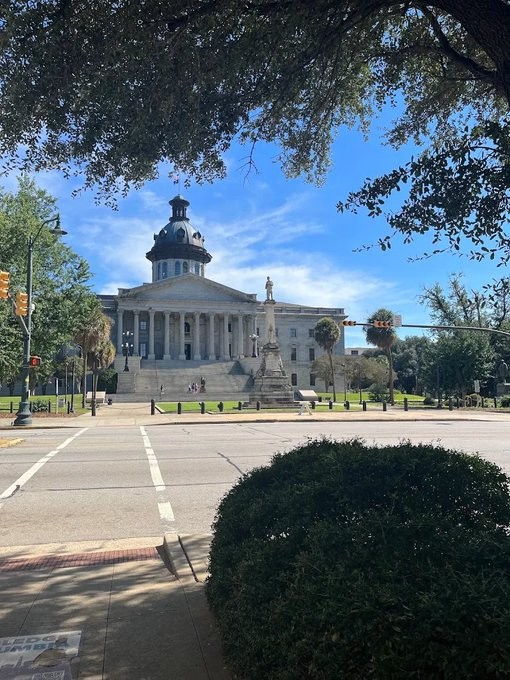
South Carolina Statehouse ca 1851
The South Carolina State House, begun in 1851 in Columbia, is one of the most important landmarks in the state and a powerful architectural symbol of South Carolina’s political history. The present building replaced an earlier State House that had been badly damaged during the burning of Columbia in February 1865. Its construction reflects the ambitions of antebellum South Carolina, while its long history encompasses the Civil War, Reconstruction, the growth of state government, and the transformation of Columbia into the modern capital city.
The building was designed by architect P. H. Hammarskold, with later architectural work by John Niernsee and subsequent architects contributing to its final form. Construction proceeded slowly because of financial difficulties, the Civil War, and the disruption caused by the conflict. The State House was eventually completed in stages, with the building receiving its distinctive appearance through a combination of nineteenth-century architectural planning and later modifications. Its long construction history makes it an especially valuable example of how major public architecture can evolve over several generations.
Architecturally, the South Carolina State House combines elements of Classical Revival and Italianate design within a monumental governmental composition. The imposing central portico, symmetrical wings, tall windows, heavy masonry construction, and prominent dome create a formal appearance appropriate to the seat of state government. The use of locally significant materials and carefully executed architectural details further reinforces the building’s civic importance. The structure was designed not simply as an office building but as a monumental expression of the authority and permanence of state government.
The State House grounds are equally important to the building’s character. Landscaped grounds, monuments, mature trees, and formal approaches create an impressive civic setting that distinguishes the property from Columbia’s surrounding commercial and residential neighborhoods. Over time, the grounds have become a place where South Carolina’s political, military, cultural, and historical memory is represented through monuments and commemorative features.
The history of the State House is inseparable from some of the most consequential events in South Carolina history. During the Civil War, construction was interrupted as the state became deeply involved in the conflict. Union forces under General William T. Sherman entered Columbia in February 1865, and the city suffered extensive destruction. The unfinished State House survived the destruction, although it sustained damage. Visible artillery strikes on the building are among the physical reminders of the war preserved in Columbia’s historic landscape.
During Reconstruction and the decades that followed, the State House became the center of South Carolina’s political life. Legislators, governors, judges, and state officials conducted the business of government within its walls as the state experienced profound political, economic, and social change. Decisions made here affected every part of South Carolina, from taxation and education to transportation, agriculture, civil rights, and economic development.
The building also reflects the changing governmental needs of the twentieth century. As state government expanded, offices and facilities were adapted to accommodate new functions and technologies. Restoration and preservation efforts have sought to protect the architectural character of the historic building while allowing it to remain an active center of government. The State House continues to function as the seat of South Carolina’s General Assembly and the offices associated with the governor and other state officials.
The South Carolina State House is therefore significant on several levels: architecturally, as one of Columbia’s most prominent nineteenth-century monumental buildings; historically, as the center of South Carolina government through periods of war, Reconstruction, modernization, and political change; and symbolically, as one of the defining landmarks of the state. Dating from the beginning of construction in 1851, the building embodies more than a century and a half of South Carolina history. Its walls and grounds form a tangible record of the state’s political aspirations, conflicts, triumphs, and continuing evolution, making the State House one of Columbia’s most important historic resources.