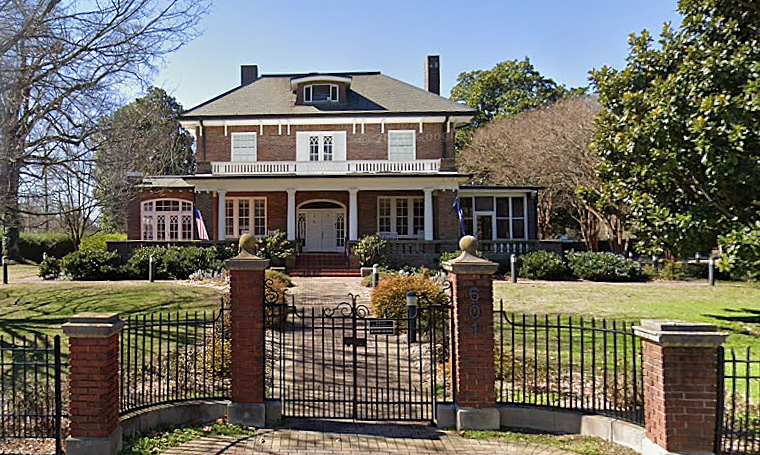
President’s Residence – Winthrop ca 1890
The President’s Residence at Winthrop University, dating to approximately 1890, represents an important part of the institution’s early architectural and educational history in Rock Hill, South Carolina. Established during Winthrop’s formative years as a college devoted to women’s education, the residence reflects the growth of the campus and the development of a permanent institutional setting. As the home of the college’s president, the building served both a domestic purpose and a symbolic role, representing the leadership, stability, and aspirations of the young educational institution.
Architecturally, a residence of this period would have reflected the late nineteenth-century tradition of substantial, comfortable homes, emphasizing practical domestic planning alongside decorative exterior details. Its location within the Winthrop campus landscape connected the private life of the college’s leadership with the broader academic community. The President’s Residence is significant for its association with Winthrop’s institutional development and the expansion of higher education for women in South Carolina, illustrating how campus buildings served both functional needs and the emerging identity of the college.
The residence was originally built by Captain W. H. Stewart around 1890 and became part of Winthrop’s permanent history when Stewart sold the property to the college in 1893. It was occupied by Winthrop’s first president, David Bancroft Johnson, in 1895, when the institution established its permanent campus in Rock Hill. Originally designed in the Queen Anne Victorian style, the two-and-a-half-story frame house featured clapboard siding, a prominent roofline, dormers, chimneys, and a distinctive rounded tower. Major renovations in 1917 substantially altered its appearance, introducing brick veneer and removing several of its original Victorian features. The residence remains historically significant for its continuous association with Winthrop’s presidents and its connection to the university’s establishment and growth in Rock Hill.