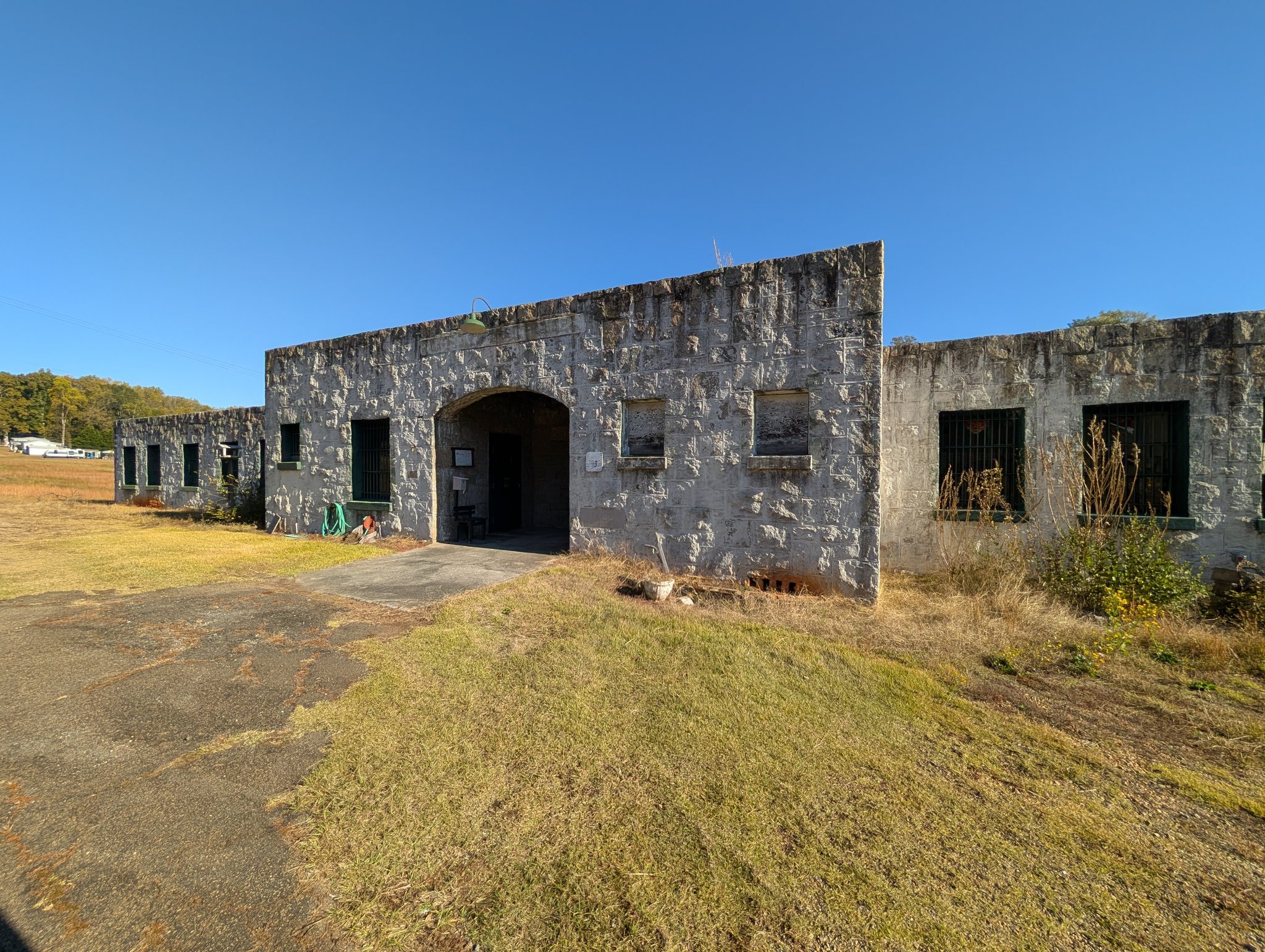
Pickens County Stockade
The Pickens County Stockade was built in 1936 under the auspices of the Works Progress Administration (WPA), the federal government’s New Deal program designed to address the dire economic situation of the Great Depression through public-works employment. Constructed of durable granite, the facility was designed to house male inmates in the county’s penal system. According to property descriptions, the building was used as a “men’s prison until 1968”.
The choice of stone and the involvement of the WPA situate the building in two intertwined narratives: the federal expansion of infrastructure in the 1930s, and the evolution of county-level penal facilities in rural South Carolina.
This dual role—detention and labor—is significant. It reflects how rural counties grappled with maintaining infrastructure (roads, public buildings) while also housing offenders, often under conditions very different from urban penitentiaries. The labor component can be seen as part of the broader pattern of penal labor in the U.S., and in South Carolina specifically, where local governments sought to use inmate labor to stretch limited budgets.
The stockade ceased functioning as a prison in 1968, when a newer facility was built. Afterward, the building went through a period of dormancy and adaptive reuse. One family purchased the old stockade, repurposed it—first as part of a car dealership and collection space, and later as “Stockade Antiques,” an antiques store which draws locals and visitors alike intrigued by the building’s past.
Imagine arriving in Pickens County in the mid-1930s, a time when the Great Depression still casts a shadow over everyday life. The roads are rough, public buildings are underfunded, and local government seeks federal assistance. Enter the newly built granite stockade: broad-minded in its ambition but austere in its purpose. Inside its walls, men serve out sentences—some short, some perhaps longer—and, under court order, pick up shovels, lay stone, build roads. They work for a county that tries to emerge from economic stagnation; the jail both confines and contributes.
Over the decades, the building stands while the world around it changes: automobiles replace horses, rural communities shift, county services expand. By 1968 the facility is outdated—and the labor-model of incarceration is under pressure. The stockade shuts down. But buildings don’t simply vanish. The stone walls now house another sort of enterprise: collectors, antiques, whispers of history. Locals traverse the parking lot not for a court date, but for a browse of vintage lamps and furniture—recast amid the echoes of past incarceration and labor.
For residents and visitors of Pickens, the stockade is more than an old building—it is a landmark where multiple strands of local history converge: 1930s federal investment; rural justice; community labor; adaptive reuse. It prompts reflection: How did our community invest in infrastructure? How were offenders incorporated into that infrastructure? What becomes of the sites of confinement when the sentences are done, the inmates gone, and the cellblocks silent?
Visiting the building today is a way to engage with that layered past—walking past granite walls, imagining the men who labored there, the roads they built, the transformations the county underwent.