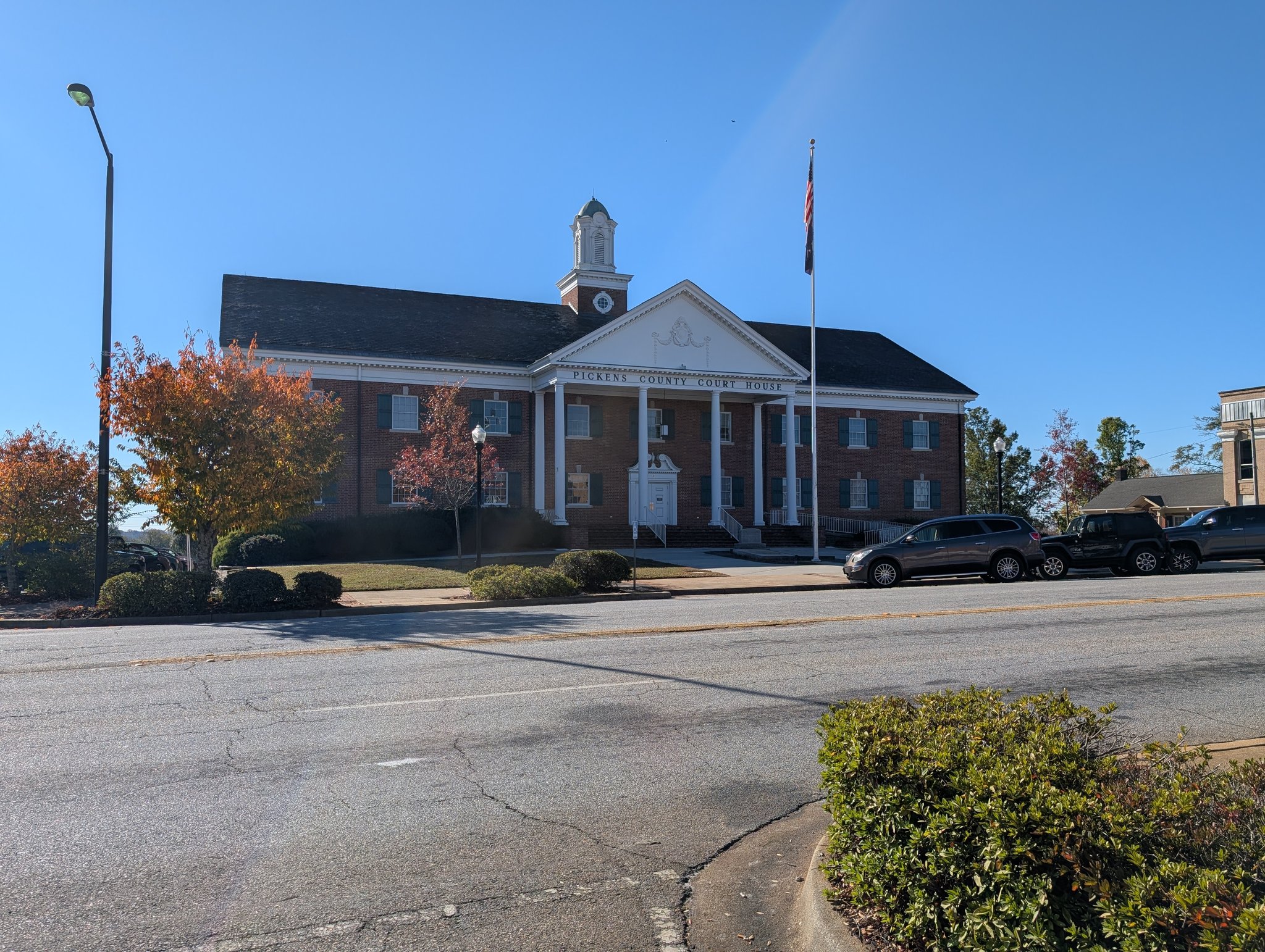
Pickens County Courthouse
The roots of court governance in Pickens County extend into the early nineteenth century, when the area was part of larger judicial district configurations. In 1828, the area was designated as the newly organized Pickens District, named in honor of Revolutionary War Brigadier General Andrew Pickens.
At that time, a courthouse was erected on the west bank of the Keowee River, and a settlement known as “Pickens Court House” emerged around it—serving as the judicial and governmental nucleus for the district. When, after the Civil War, the reorganization of districts into counties took effect (in 1868), the county seat was formally located at what is now the town of Pickens. Thus the courthouse’s story begins amid frontier-era infrastructure, not just of law and governance, but of establishing civic presence in a relatively remote mountain foothills region.
As the county grew, so did the need for more substantial facilities. The records suggest the first official courthouse building of the newly formed county in 1868 was succeeded by a second in 1891, and the present building dates from 1959–1960. The current structure, located at 214 E Main Street in Pickens, is a two-story red brick and concrete building in a Georgian Revival style, with a prominent portico and cupola. The courthouse has served as more than a venue for adjudication. It has functioned as the stage for the county’s governance: law-making, public meetings, record‐keeping, and public rituals.
- It anchors the town square of Pickens, forming a symbolic heart of local life.
- It marks the shift of the county seat eastward following regional reorganization—a reminder of how geography, infrastructure (roads, railroads) and population shifts intersect in public‐administrative decisions.
- The courthouse stands amid the transitions of Pickens County—from its early agricultural era through the emergence of railroads, textile mills, saw-mills and broader industrialization.
By the turn of the 20th century, things were changing rapidly: rail lines, mills, timber and bricks emerged; transportation improved; the courthouse-town became more central to civic life. Mid-century, the present courthouse was built—its design reflecting confidence in permanence and the idea of public service as an enduring civic enterprise.
To walk inside its halls is to tread into decades of local memory: jury trials and family-court hearings, elections and public gatherings, record-books marking births, deaths, land transfers. The building mirrors the county’s story—its roots in wilderness and settlement, its engagement with the modern world, its ongoing adaptation.
The Pickens County Courthouse is more than brick and mortar. It is a repository of local memory, a marker of civic ambition, and a mirror of regional transformation. From its early days as a settlement courthouse on the Keowee River to its mid-20th-century incarnation in downtown Pickens, it has charted the story of how law, community and place intertwine.