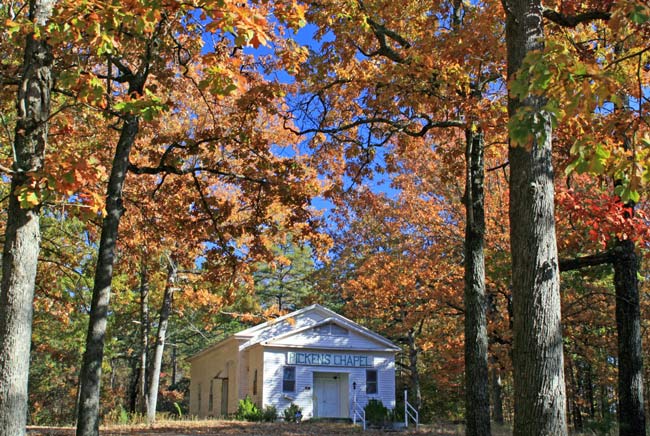
Pickens Chapel in Easley
Nestled quietly off a wooded road near Easley in the Upstate of South Carolina, Pickens Chapel stands as a modest yet resonant symbol of faith, community, and the shifting religious landscape of the region. Its layered history spans the earliest frontier church-plants of the late 1700s through denominational realignment and into the 20th-century ebb of rural congregations. What follows is a flowing narrative of its historical significance.
The story begins with the settlement of the foothills region by Scots-Irish and other frontier families in the years following the American Revolution. The land around Three and Twenty (24) Mile Creek became home to members of the distinguished Robert Pickens family (a cousin of Revolutionary-War hero Andrew Pickens), who were instrumental in organizing worship gatherings in the area around 1785.
Initially, a Presbyterian congregation known as Richmond Church (or sometimes Twenty Three Mile Church) and its log meeting-house were established. Later, around 1802, many of the congregation shifted to Methodism, and a new church structure was built on the Pickens land, reflecting both denominational change and local agency.
Although the origins of worship on the site date back to the 18th and early 19th centuries, the present brick church building widely attributed to Pickens Chapel was erected in 1888.
This late-19th-century construction marks a transition: from frontier meeting-house to more permanent, community-anchored place of worship. The building stood as a witness to the rural life of the era—farm families, local schools, church socials and the cemetery adjacent to the chapel all tied together communal rhythms of work and worship.
Over time, the congregation of Pickens Chapel experienced the broader forces of religious evolution: schisms between denominations, small-community decline, and repurposing of church buildings. For instance:
- The original Presbyterian/Methodist division in the early 1800s at the nearby Carmel/Richmond site reflects the interplay between religious identity and settlement patterns.
- In the 20th century, Pickens Chapel’s Methodist congregation disbanded in the late 1920s. The building was later used by a Pentecostal group (such as a Church of God branch) through the 1950s–60s, before ultimately ceasing regular services.
This shifting use is emblematic of rural churches across the Upstate: as populations changed, denominations re-aligned, and economic patterns shifted, the institutions built in one era had to adapt—or gradually fade. Pickens Chapel thus stands as a marker of that process.
Picture the landscape in the late 18th century: families clearing timber, cultivating small farms, living near creeks and hills. Into that world came itinerant ministers, brush-arbors under oaks, and the first log meeting-house near Three and Twenty Mile Creek, founded around the Pickens land. Then, as the 19th century matured, the congregation put down deeper roots. In 1888 the brick building rose—a sign of permanence in a still-rural world.