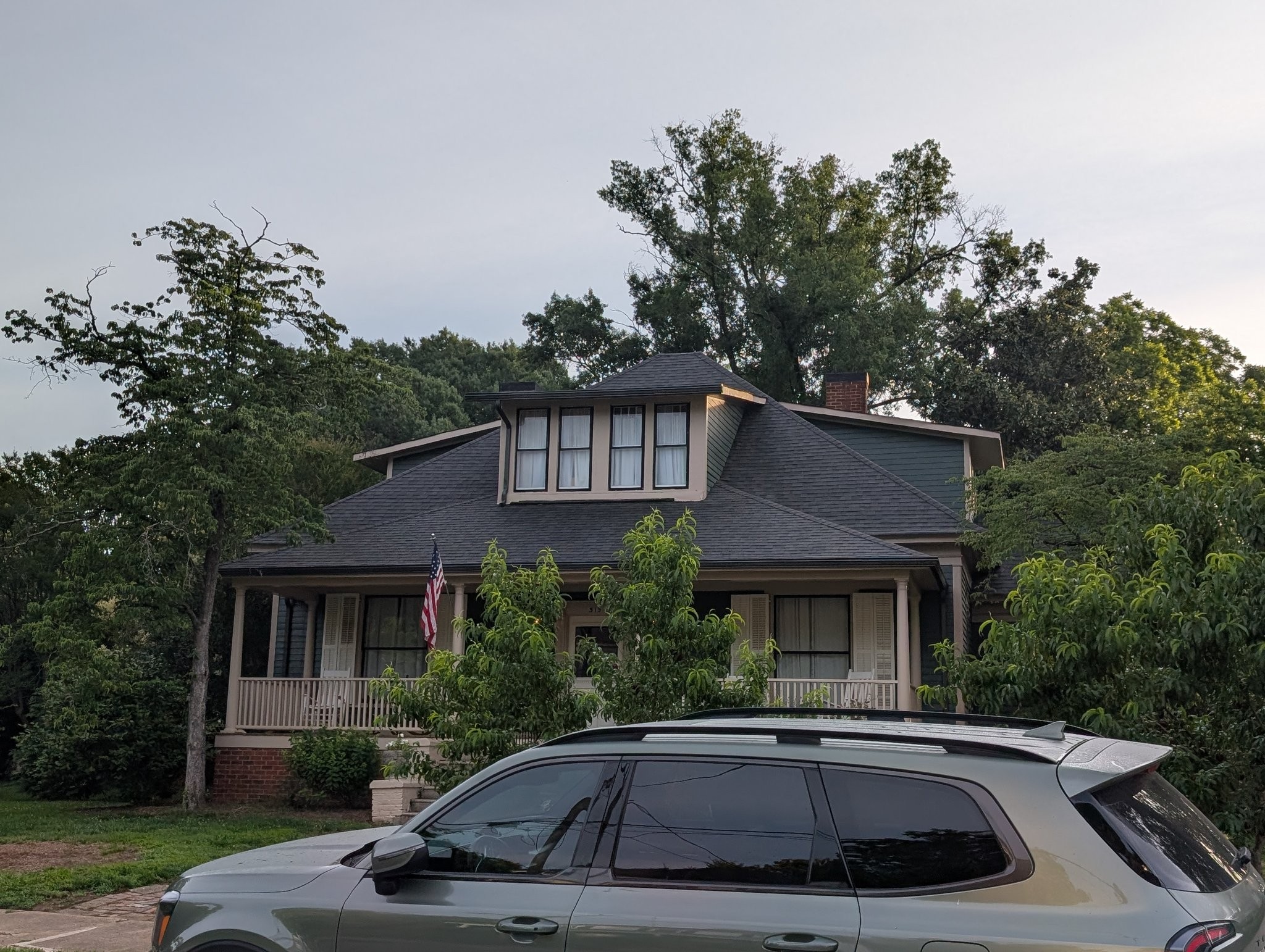
Otis P. Thompson house ca 1910
Constructed around 1910, the Otis P. Thompson House stands as a representative example of the substantial residences built during one of Rock Hill’s most significant periods of growth and prosperity. Located along Marion Street, one of the city’s premier early twentieth-century residential corridors, the house reflects the emergence of Rock Hill as a thriving commercial, educational, and industrial center in the South Carolina Piedmont. The property is identified as a contributing resource within the Marion Street Area Historic District, a neighborhood noted for its collection of architecturally significant homes constructed between the late nineteenth and early twentieth centuries.
The residence was built during a period when Rock Hill was experiencing rapid expansion fueled by textile manufacturing, railroad commerce, and the growing influence of Winthrop College. Prosperous business owners, professionals, and civic leaders established homes along Marion Street, creating a distinguished residential neighborhood characterized by broad lots, tree-lined streets, and architecturally fashionable dwellings. The Thompson House reflects this era of confidence and development, embodying the residential aspirations of Rock Hill’s emerging middle and upper-middle classes.
Architecturally, the house exhibits characteristics commonly associated with the Colonial Revival movement that dominated American domestic architecture during the early twentieth century. Symmetrical massing, classical detailing, spacious porches, and carefully proportioned façades conveyed a sense of permanence, refinement, and respectability. Like many homes erected in Rock Hill during this period, the residence blended traditional forms with modern conveniences, illustrating the transition from Victorian-era design toward the more restrained architectural styles of the new century.
As a contributing property within the Marion Street Area Historic District, the Otis P. Thompson House helps illustrate the evolution of one of Rock Hill’s most important historic neighborhoods. Together with neighboring residences, it forms part of a cohesive architectural landscape that documents the city’s residential growth and changing social patterns during the first decades of the twentieth century. The house remains an important reminder of the families, businesses, and institutions that shaped Rock Hill’s emergence as one of South Carolina’s leading Piedmont communities.