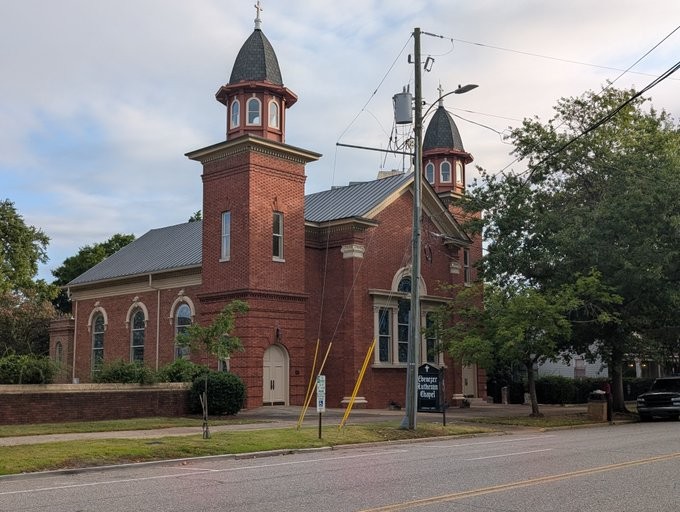
Old Ebenezer Lutheran Church, ca. 1870 — Columbia, South Carolina. Located at 1307 Richland Street, the Old Ebenezer Lutheran Church—now known as Ebenezer Lutheran Chapel—stands on the site of Columbia’s first Lutheran congregation, founded in 1830. The original church was destroyed in the fires that swept through Columbia during the final days of the Civil War, and the present brick sanctuary was completed in 1870 through contributions from Lutheran congregations in South Carolina and the North. Designed by Gustavus Theodore Berg, the German-born architect who had assisted John Niernsee with the rebuilding of the South Carolina State House, the original building was a relatively simple rectangular brick hall church with a four-bay nave, polygonal apse, and small gabled narthex. Its restrained post-Civil War design reflected both the practical needs of a congregation rebuilding after wartime destruction and Berg’s architectural training, while establishing a durable landmark on Richland Street.
The building was dramatically enlarged and remodeled in 1899–1901 under Columbia architect William Augustus Edwards, transforming Berg’s modest sanctuary into the more elaborate landmark seen today. Edwards added a bay to the nave and created a new façade centered on a large Palladian stained-glass window, flanked by two square brick towers originally crowned with distinctive cupolas. Flemish-bond brickwork with glazed headers, brick pilasters with terra-cotta capitals, finely detailed art glass, and an intricate pressed-metal ceiling enriched the interior, while the chancel and organ platform retain important historic detailing. The congregation continued to worship in the chapel until the construction of the larger Gothic Revival church next door in 1931. Listed in the National Register of Historic Places in 1979, the Old Ebenezer Lutheran Church remains an important expression of Columbia’s post-Civil War rebuilding and Lutheran heritage; its restored twin cupolas, reconstructed from historic photographs and installed in 2017, have returned a defining feature of its turn-of-the-century appearance.