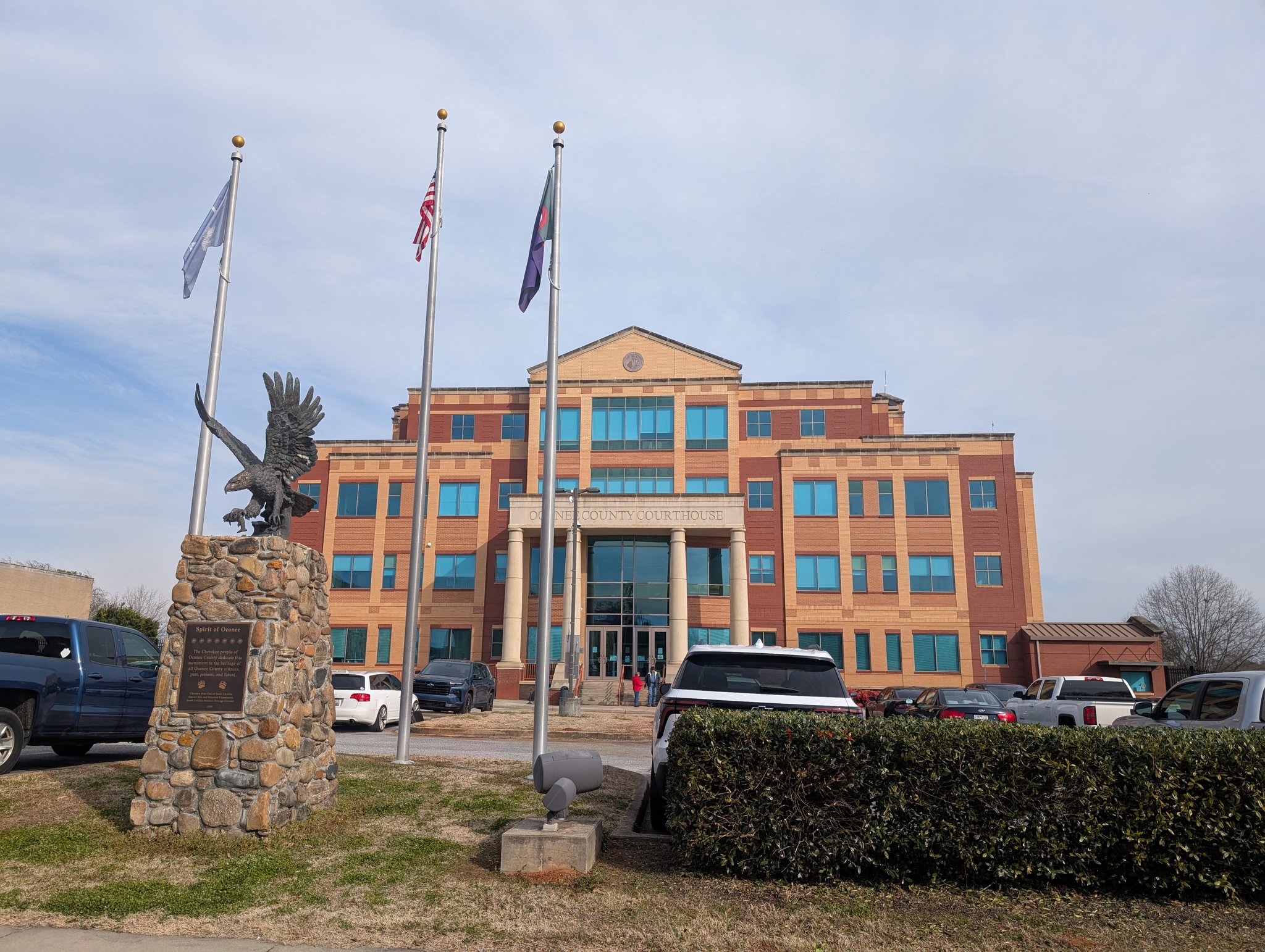
Oconee County Courthouse
Rising along West Main Street in the heart of Walhalla, the Oconee County Courthouse stands as a quiet but confident marker of mid-twentieth-century civic ambition. Completed in 1956, the building emerged during a period of postwar growth and optimism, when Oconee County sought a courthouse that would reflect both the stability of its institutions and its readiness to embrace the modern age.
Designed by the prominent architectural firm Lyles, Bissett, Carlisle & Wolff, the courthouse departed from the ornate revival styles that had long defined Southern civic buildings. Instead, it adopted a restrained modern classicism—often described as Starved Classicism—characterized by clean lines, balanced proportions, smooth masonry surfaces, and expansive glass. The design conveyed dignity and authority without excess ornament, reflecting a mid-century belief that government buildings should project efficiency, transparency, and permanence.
For nearly five decades, the courthouse served as the center of Oconee County’s judicial and administrative life. Within its walls, legal disputes were settled, public records preserved, and civic decisions made that shaped the daily lives of county residents. Its location in downtown Walhalla reinforced the town’s role as the county seat and strengthened the courthouse’s presence as a civic anchor within the community.
By the early twenty-first century, growing space and functional needs led the county to construct a new courthouse nearby, and the 1956 building ceased its original use in 2003. Though no longer the primary seat of county government, the structure retained its architectural integrity and continued to stand as a physical reminder of a transformative era in Oconee County’s history.
Recognition of its significance came in 2016, when the Oconee County Courthouse was listed on the National Register of Historic Places. This designation acknowledged the building not only for its role in local governance, but also for its importance as a rare and well-preserved example of mid-century civic architecture in the South Carolina Upstate.
Today, the courthouse remains a symbol of Walhalla’s civic identity—an enduring expression of mid-twentieth-century ideals, balancing tradition with progress, and reflecting a moment when architecture was used to communicate confidence in the future of community and government alike.