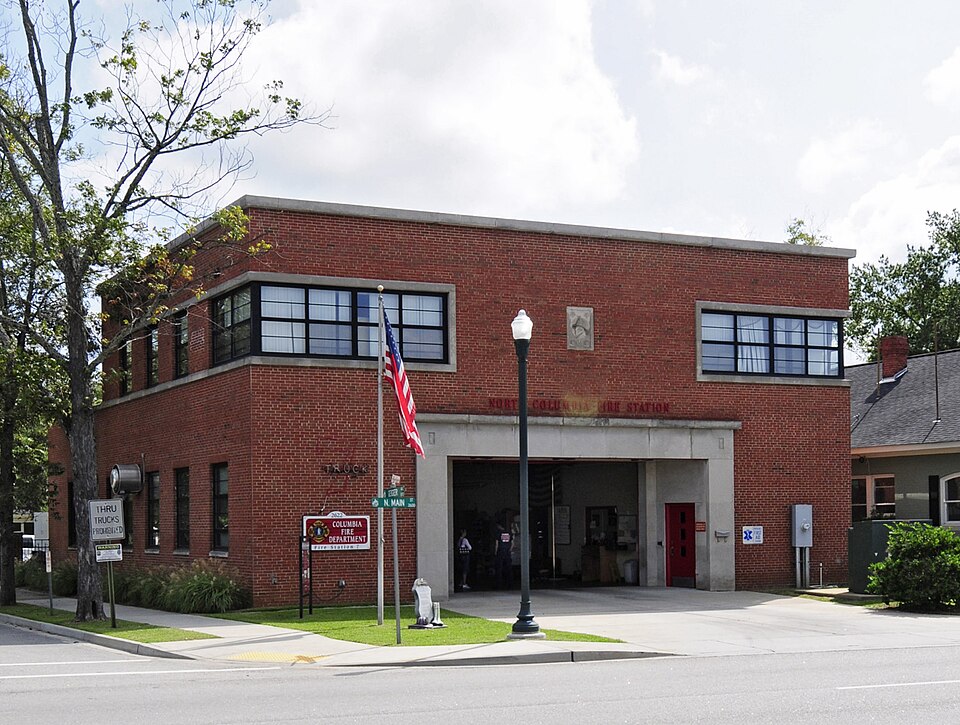
North Columbia Fire Station ca 1948
The North Columbia Fire Station, constructed about 1948, is an important example of the practical civic architecture that accompanied the growth of Columbia’s neighborhoods during the years immediately following World War II. Built to serve the expanding northern portion of the city, the station reflects the increasing need for strategically located municipal fire facilities as Columbia’s population spread beyond the traditional downtown core. Its construction belongs to a period when cities throughout the South were modernizing their public-safety infrastructure and replacing older neighborhood facilities with purpose-built stations designed around increasingly sophisticated firefighting equipment.
Architecturally, the North Columbia Fire Station is characterized by the restrained, functional appearance typical of mid-twentieth-century municipal buildings. Rather than relying upon elaborate ornament, the design emphasizes practicality, durability, and efficient circulation. The building’s principal feature is its apparatus area, with large vehicle bays designed to accommodate fire engines and other emergency equipment. Broad openings at the front provided rapid access to the street, allowing firefighters to respond quickly to alarms. The straightforward massing and simple exterior detailing reflect the utilitarian character of postwar public architecture.
The station’s design also illustrates the changing technology of firefighting during the middle decades of the twentieth century. By the late 1940s, municipal departments increasingly depended upon motorized apparatus, improved pumps, ladders, hoses, and specialized emergency equipment, requiring larger and more carefully organized facilities than those associated with the horse-drawn fire companies of the nineteenth and early twentieth centuries. A neighborhood station such as North Columbia therefore functioned as both a garage for expensive municipal equipment and a workplace where firefighters could remain ready for immediate deployment.
The construction of the station also reflects Columbia’s broader pattern of postwar suburban and neighborhood expansion. The city was experiencing substantial residential development outside the traditional downtown business district, and fire protection had to expand with it. Locating a station in North Columbia reduced response times and placed emergency services closer to the neighborhoods, schools, commercial properties, and transportation routes developing in the area. In this respect, the station represents the practical side of Columbia’s physical growth during the middle twentieth century.
Inside, a neighborhood fire station typically incorporated more than apparatus storage. Facilities of this period commonly included firefighter sleeping quarters, offices, a kitchen or day room, equipment-storage areas, and support spaces, allowing personnel to remain at the station for extended periods. These arrangements reflected the demanding nature of municipal firefighting and the transition toward professional, continuously staffed departments. The building’s organization therefore combined public-safety functions with residential and workplace accommodations.
The North Columbia Fire Station is significant as part of Columbia’s history of municipal services and public infrastructure. Fire stations rarely receive the architectural attention given to courthouses, banks, churches, or residences, yet they provide an important record of how communities organized essential services. A station such as this documents the city’s investment in neighborhood protection and demonstrates the relationship between population growth, technological change, and municipal planning.
Its approximately 1948 construction date is also historically important because it places the station within the immediate postwar period, when Columbia was entering a new era of growth. The city increasingly required modern public facilities capable of supporting larger populations and more dispersed neighborhoods. The North Columbia station thus represents a transition between the earlier firehouses of the traditional city and the larger, specialized emergency facilities that became common in the later twentieth century.
The building’s value lies especially in its ability to convey the everyday history of Columbia’s fire service. Its apparatus bays, functional plan, durable construction, and modest architectural vocabulary embody the priorities of a municipal building whose principal purpose was to protect lives and property. Unlike monumental civic buildings designed primarily to express governmental authority, the North Columbia Fire Station expressed civic responsibility through accessibility, efficiency, and readiness.