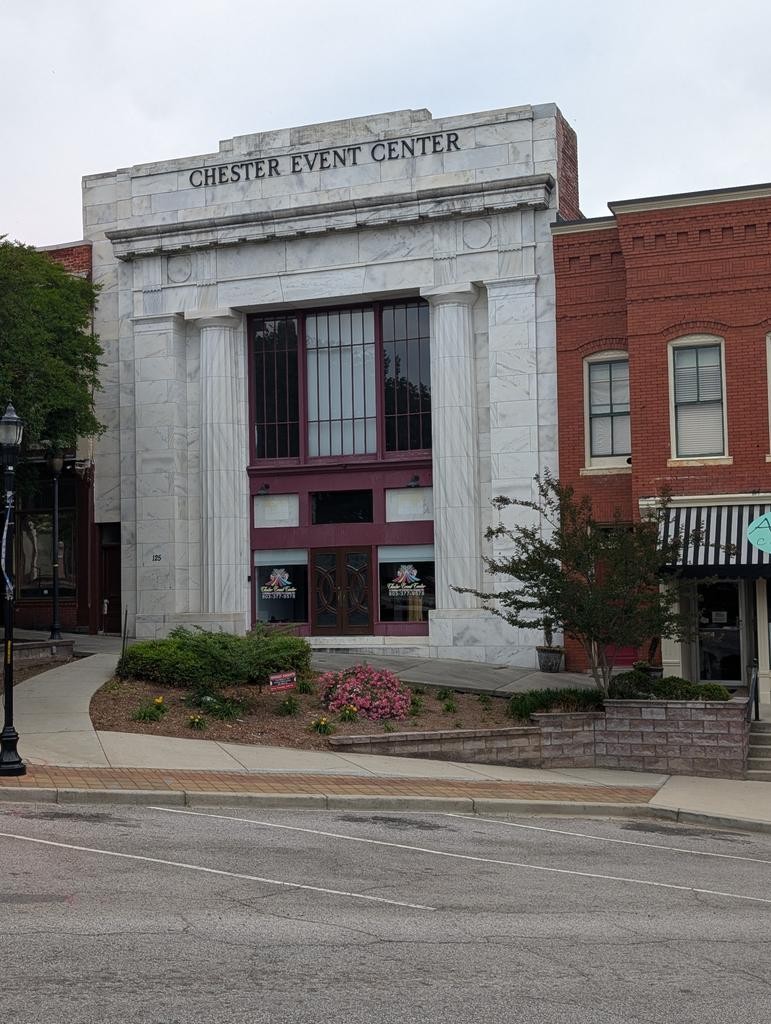
National Exchange Building (ca. 1919)
The National Exchange Building (ca. 1919) stands as a prominent expression of early 20th-century commercial confidence in Chester, reflecting a period of renewed economic optimism following the World War I. Constructed during a time when small Southern cities were modernizing their downtown districts, the building embodies both practicality and understated architectural refinement.
Typically associated with early Commercial style influences, the National Exchange Building presents a solid, rectilinear form designed for efficiency and urban presence. Its façade is commonly organized into a clear grid of window bays, emphasizing order and function. The use of brick masonry anchors the structure visually and physically, conveying durability and permanence in the heart of the commercial district.
At street level, large storefront openings would have originally accommodated banking or retail functions, with broad display windows and recessed entryways designed to invite public engagement. Above, upper floors are articulated with evenly spaced sash windows, providing light and ventilation for offices and professional spaces. Subtle decorative detailing such as brick lintels, modest cornice work, or parapet articulation adds refinement without compromising the building’s utilitarian focus.
Inside, the structure would have been arranged to support financial and commercial activity, with open, adaptable floor plans typical of early 20th-century office buildings. The presence of a bank or exchange function suggests a layout designed for public transactions, private offices, and secure administrative areas, reflecting the building’s role in Chester’s economic infrastructure.
As a civic and commercial landmark, the National Exchange Building symbolizes the transition of Chester into a more modernized urban economy in the early 1900s. Its enduring presence in the downtown landscape highlights both the architectural character and the financial history of the community, standing as a reminder of the town’s evolution in the postwar period of growth and development.