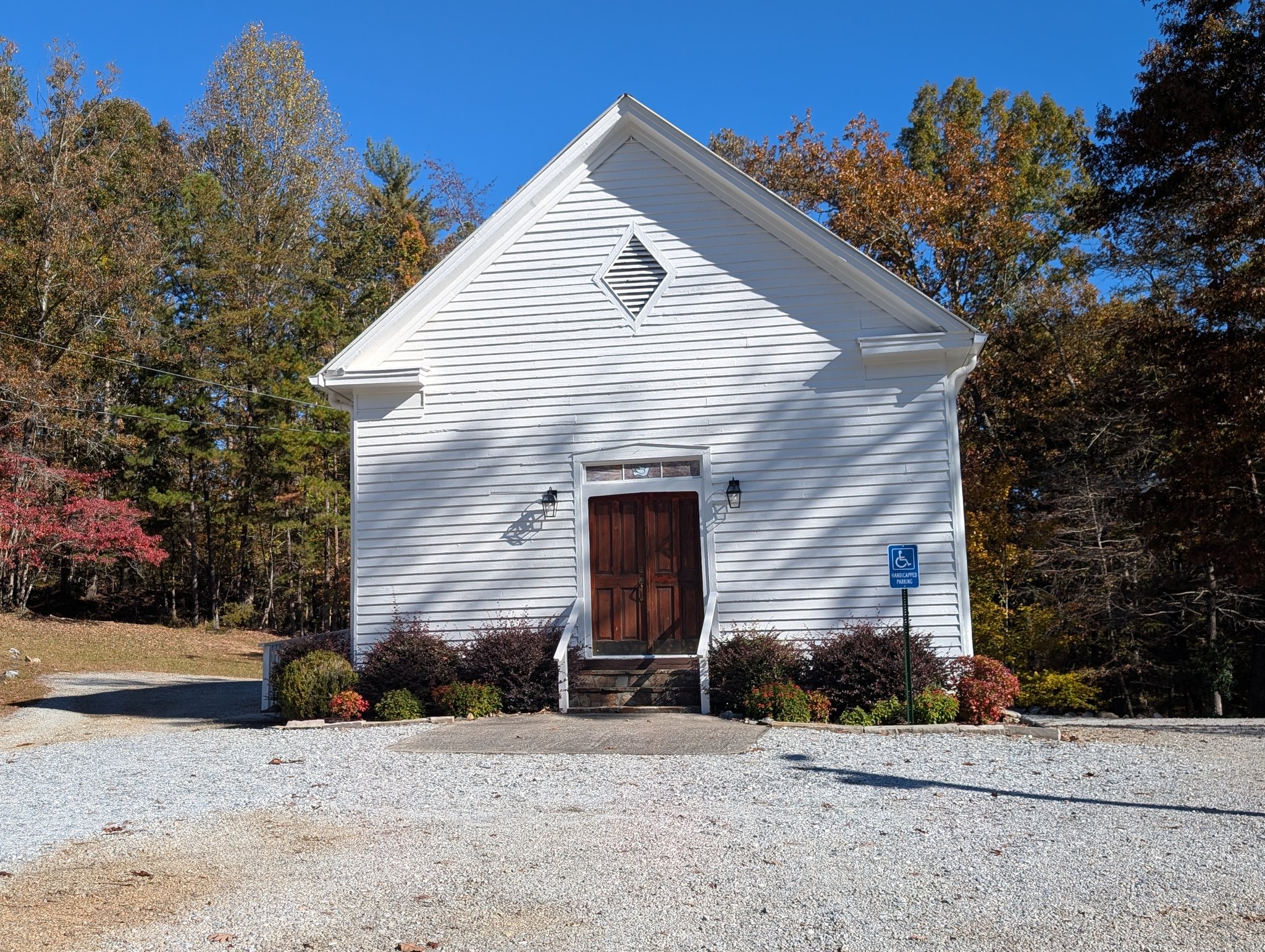
McKinney Chapel in Sunset
The McKinney Chapel, nestled in the quiet forested stretches of the Eastatoe Valley near Sunset, South Carolina (Pickens County), stands as a small but richly resonant landmark — one that embodies over two centuries of settlement, community faith, and rural life in the Upstate of South Carolina.
The roots of McKinney Chapel reach back to the early 19th century. Around 1820, John McKinney, a settler in the Eastatoe Valley, laid aside land for a log structure intended to serve both as a school and a church for the surrounding families.
Local families — among them the McKinneys, Stewarts, Bowies, Ellenburgs and Chapmans — came together across denominational lines to build and use the site.
In this way, the chapel’s foundation captures a key moment in Upstate South Carolina: the frontier‑to‑community transition, when settlers carved farms, built roads, and formed institutions of faith and education in a once remote valley.
While the earliest log structure dates to 1820, the current chapel building was constructed in 1891. This brick or wood‑frame structure (depending on available sources) marks the evolution from rough frontier meeting house to a more permanent institution. It signals that the valley community had matured: stable families, a congregation enough to build, and a settled landscape.
Adjacent to the chapel is a cemetery containing many early settlers and their descendants — a tangible link to the heritage of the valley. Walking the ground you sense how worship and memorialization were intertwined in rural life: church Sunday, then care of the dead, the cemetery as part of the church property and the community.
For many decades the chapel served its local community: as place of worship, gatherings, education, and social connection. Over time however, as population patterns changed, congregations shifted, and transport improved, the role of rural chapels like McKinney diminished.Notably, in the early 1980s the chapel was in a state of decline but was rescued by local volunteers led by Georgia Chapman, whose restoration efforts helped to preserve the building and cemetery.
More recently, in January 2023 the property was purchased by the McKinney Chapel Committee of Lake Keowee, Inc. (a nonprofit) to ensure its future as a community‑owned asset for worship, celebration, memory and gathering. The chapel continues to host monthly ecumenical services (the fourth Sunday of each month) and is open for weddings and community uses — signifying how historic religious buildings can adapt to 21st‑century contexts while retaining their heritage.
Decades pass, the valley grows, the original structure gives way to the 1891 chapel — a sign that the families had anchored themselves, that the land and its people persisted. The church hosts Sunday services, weddings, funerals. A cemetery fills slowly with markers of those who lived, loved, labored, and died in that valley.
The 20th century brings highways, mobility, population shift. The chapel’s congregation thins. But a dedicated few refuse to let the building vanish. In the 1980s, Georgia Chapman leads restoration; in the 2020s, the Chapel Committee secures ownership and begins a new chapter.