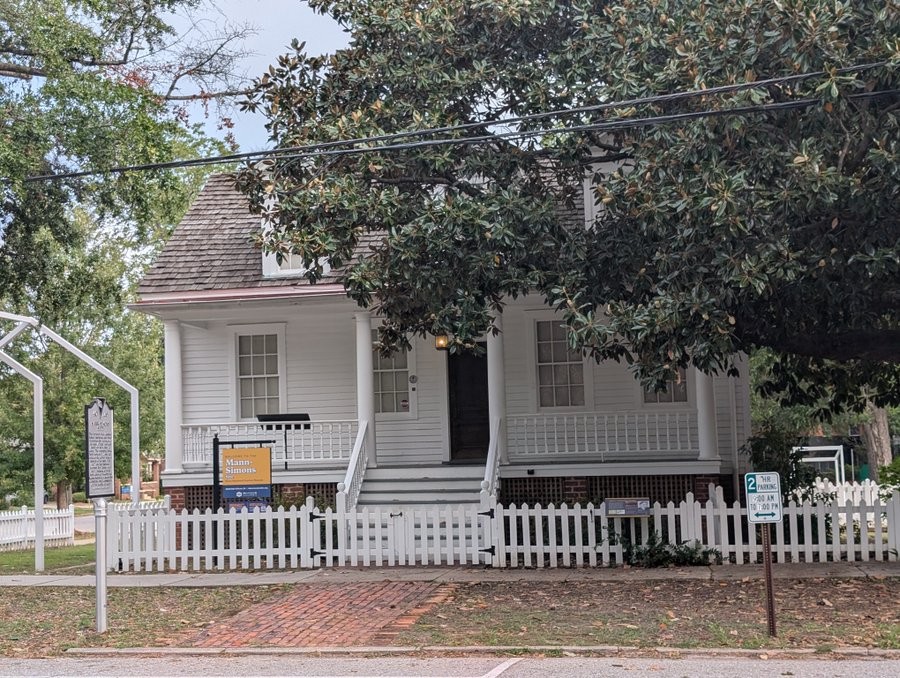
The Mann-Simons House, also known as the Mann-Simons Cottage or Simons Cottage, at 1403 Richland Street in Columbia, is an exceptionally important surviving resource associated with the city’s antebellum free Black community. Traditionally dated circa 1850, the property was occupied by Celia Mann, a free African American woman who was born enslaved in Charleston in 1799, obtained her freedom, and moved to Columbia, where she supported herself as a midwife. Mann and her family were among the relatively small number of free Black residents living in Columbia before the Civil War. The property became an important center of family, religious, and community life, and its basement was used for worship by early African American Baptists before permanent church buildings were established. The house is a modest one-and-one-half-story frame residence with a central-hall plan, representing the vernacular domestic architecture of nineteenth-century Columbia rather than the more elaborate residences of the city’s white elite.
The history of the Mann-Simons property extends well beyond its antebellum origins and provides an unusually complete record of African American life in Columbia through Reconstruction and into the twentieth century. After Celia Mann’s death in 1867, the property passed to her daughter Agnes Jackson, and descendants of Jackson’s second husband, Bill Simons, remained associated with the house for generations. The present cottage incorporates alterations and additions made during the nineteenth and early twentieth centuries, reflecting the continuing adaptation of the property to changing family needs. The Mann-Simons House was listed in the National Register of Historic Places in 1973 under areas of significance including Black history, music, religion/philosophy, and social history, and it is now operated as a historic house museum interpreting the experiences of free and formerly enslaved African Americans in Columbia. Its survival is particularly significant because it preserves not only an early vernacular dwelling but also a tangible setting for understanding the social, religious, economic, and cultural contributions of Columbia’s Black community before and after emancipation.