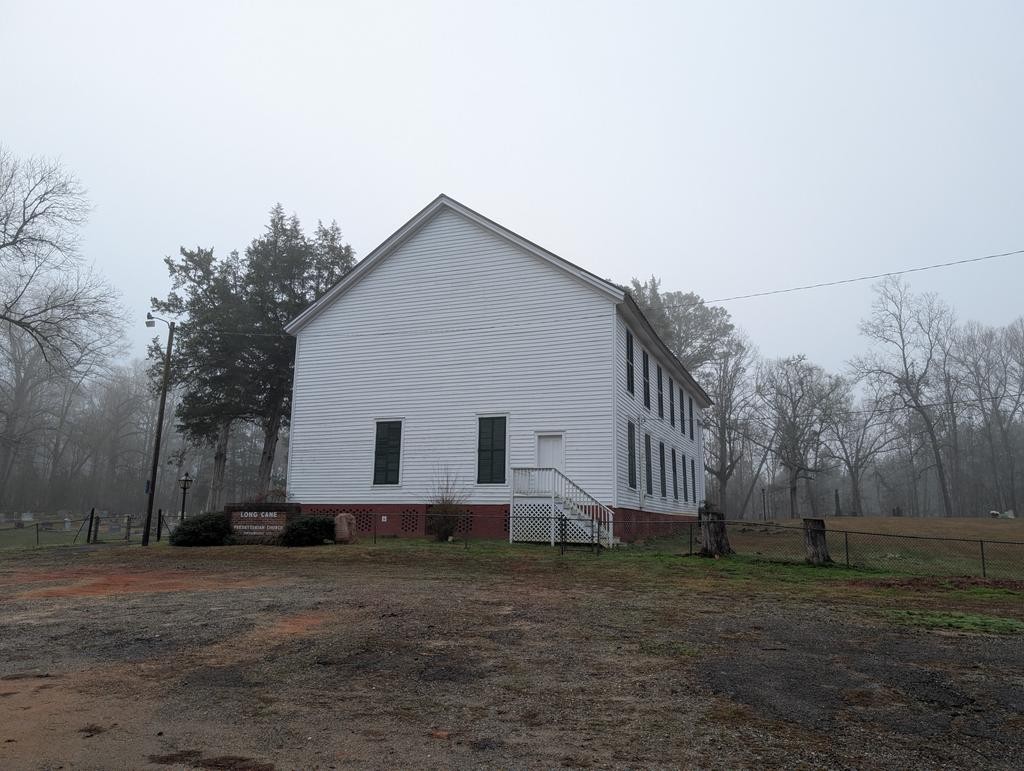
Perched amid the gentle countryside of Troy, Long Cane Presbyterian Church stands as one of the oldest and most historically significant congregations in South Carolina’s upcountry. Established in the mid-eighteenth century by Scotch-Irish settlers, the church became a spiritual anchor for families who had migrated to the region seeking fertile land and a community rooted in the Presbyterian faith.
The congregation formally organized in 1767, making it one of the earliest in the area. During its early years, worship services were often held in modest meeting houses or private homes, reflecting the pioneer conditions of frontier life. As the community grew and prospered, the congregation constructed a permanent sanctuary, which came to embody the classical simplicity and dignity characteristic of Presbyterian architecture of the era. Its unadorned yet elegant design emphasized the centrality of preaching and congregational participation, core values of the Presbyterian tradition.
Long Cane Presbyterian Church also played a vital role in education and civic life. Ministers from the church often provided instruction to local youth, and the church itself became a gathering place for discussions on community matters. During the turbulent years of the American Revolution and later the American Civil War, the congregation’s members were deeply involved in both local and regional affairs, leaving a mark on the political and social development of Abbeville County.
Over the centuries, Long Cane Presbyterian Church has remained an enduring testament to the faith, resilience, and civic engagement of its members. Its historic sanctuary and surrounding grounds continue to welcome worshippers and visitors alike, preserving the legacy of one of South Carolina’s oldest Presbyterian communities and offering a tangible link to the region’s rich cultural and spiritual heritage.