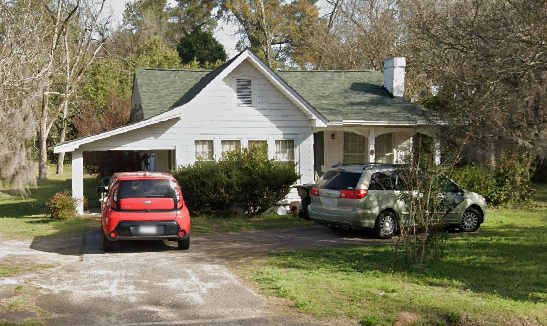
Constructed around 1928, the Judge Hemrick N. Salley House stands as one of the most distinguished residences in Salley and reflects the prosperity and civic prominence of one of the community’s leading citizens during the early twentieth century. Built during a period of continued growth following the town’s establishment as a railroad and agricultural center, the residence embodies the architectural refinement and social status associated with successful professional families in rural South Carolina. As a contributing property within the Salley Historic District, the house represents an important chapter in the community’s residential development during the interwar years.
The home is notable for its substantial scale, balanced proportions, and carefully executed architectural detailing. Influenced by the Colonial Revival style that dominated American domestic architecture during the 1920s, the dwelling features a symmetrical composition, prominent entrance treatment, and traditional design elements that conveyed permanence, stability, and respectability. Its orderly façade, generous porch spaces, and well-crafted woodwork reflect the preference for classical forms that characterized upper-middle-class residential construction throughout South Carolina during the period.
The residence was home to Judge Hemrick N. Salley, a prominent attorney, jurist, and civic leader whose career brought distinction to both Salley and Aiken County. As a respected member of the legal profession, Judge Salley played an important role in the public life of the region, and his home became closely associated with the social and professional leadership that helped shape the community during the first half of the twentieth century. The property’s association with Judge Salley enhances its historical significance and illustrates the influence of local leaders in the development of small-town South Carolina.
Situated among other historic residences within Salley’s traditional residential neighborhood, the Judge Hemrick N. Salley House contributes substantially to the architectural character of the town. Its preservation provides a tangible link to the era when Salley served as a thriving agricultural and commercial center, while also commemorating the legacy of one of the community’s most prominent citizens. Today, the house remains an important landmark within the Salley Historic District, reflecting both the architectural tastes and civic aspirations of South Carolina’s small-town elite during the late 1920s.