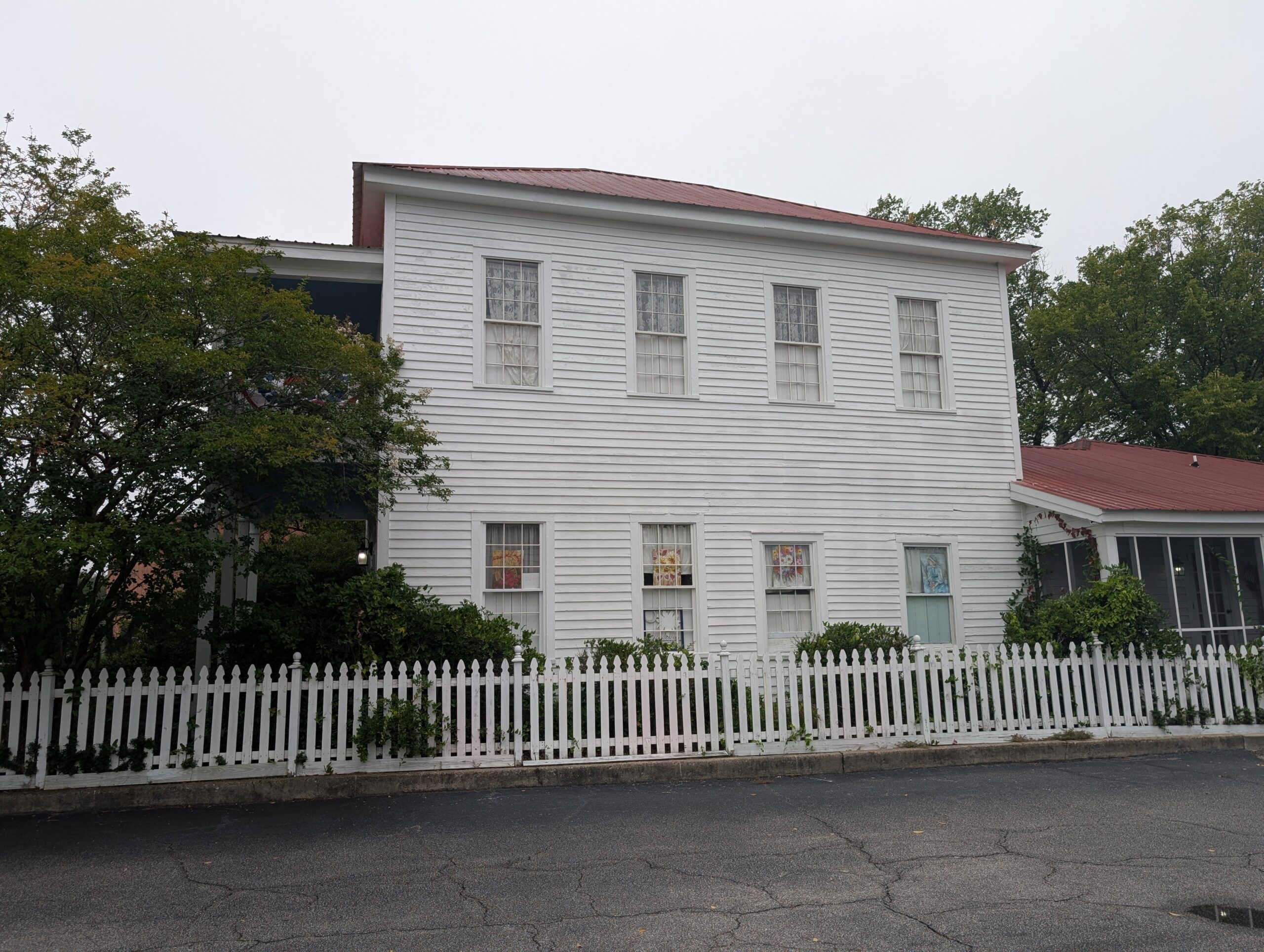
James Harman Building ca 1901
Constructed around 1901, the James Harman Building stands as one of Lexington’s finest surviving examples of early twentieth-century commercial architecture and serves as an enduring reminder of the town’s professional and commercial growth at the turn of the century. Built for Dr. James Harman (1845–1928), one of Lexington’s leading dentists, by Georgia contractor U.U. Campbell, the building has continuously housed professional offices since its completion. Listed in the National Register of Historic Places in 1983, it is recognized for its architectural integrity, its association with Lexington’s early professional community, and its survival of the devastating downtown fire of 1916, which destroyed much of the town’s commercial district.
The two-story brick structure is a well-preserved example of vernacular commercial design influenced by late Victorian architectural traditions. Rectangular in plan and capped by a flat roof concealed behind a parapet, the building features a richly detailed façade with a corbeled brick cornice, projecting wall pilasters, and three evenly spaced bays on each floor. The first story originally centered on a double-door entrance topped by a semicircular transom and flanked by large six-over-six sash windows. Projecting brick arches visually unite the window openings on both stories, while the side elevations are punctuated by vertically aligned six-over-six windows with flat brick arches. These carefully executed masonry details provide both structural rhythm and visual distinction, reflecting the quality of commercial construction during Lexington’s period of economic expansion.
From its earliest years, the James Harman Building served as an important center for professional services in Lexington. Dr. Harman established his dental offices in the building, and over subsequent decades it accommodated physicians, attorneys, and other professionals whose practices contributed to the civic and economic development of the county seat. Its continuous use for professional offices for more than a century illustrates the stability and importance of the building within downtown Lexington and underscores its role as a local landmark for generations of residents.
The building’s greatest historical distinction came in 1916, when a catastrophic fire swept through Lexington’s business district. While many neighboring commercial structures were destroyed, the James Harman Building was one of only five downtown commercial buildings to survive the blaze. Its survival preserved an authentic example of Lexington’s pre-fire architectural character and provided a tangible link to the town’s appearance before one of the most significant disasters in its history. Today, the James Harman Building remains one of downtown Lexington’s most recognizable historic landmarks, representing the craftsmanship, resilience, and professional heritage that shaped the community during the early twentieth century.