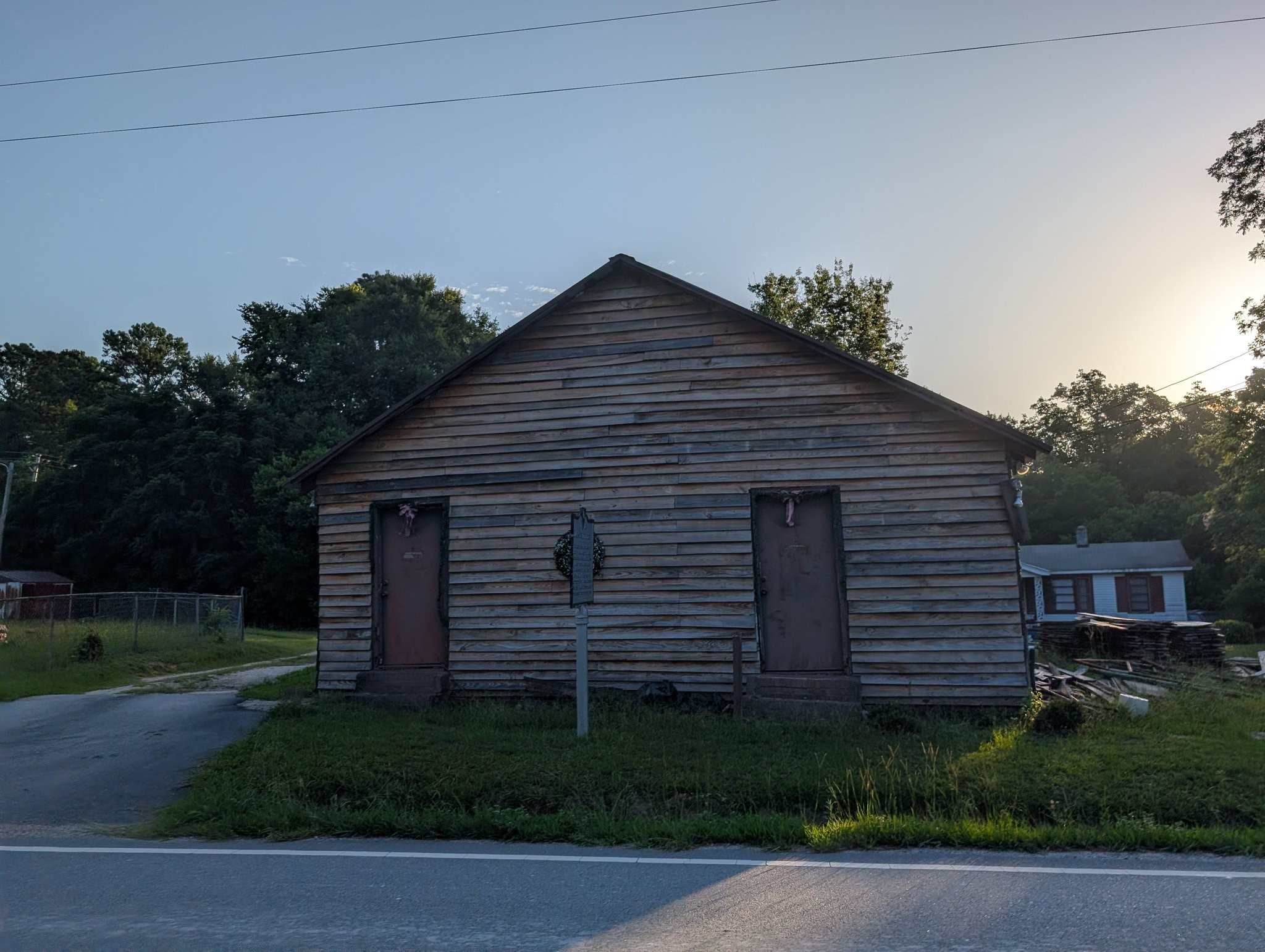
Jacksonville School ca 1895
Constructed around 1895, Jacksonville School represents the important role that small rural schools played in the educational and social development of Aiken County communities during the late nineteenth and early twentieth centuries. Built during an era when education was becoming increasingly organized throughout South Carolina, the school provided children in the Jacksonville community with access to basic instruction in reading, writing, arithmetic, and other foundational subjects. Beyond its educational purpose, the schoolhouse served as a gathering place where families, teachers, and neighbors came together, making it an important center of community life.
The building reflects the traditional design of the late nineteenth-century rural schoolhouse. Constructed as a modest frame structure, Jacksonville School features a simple rectangular plan, weatherboard siding, a front-gabled roof, and large wood windows arranged to provide natural light and ventilation for the classroom. The straightforward design reflects the practical needs of rural education, where buildings were often constructed using locally available materials and community labor. A single classroom layout, wooden floors, and functional interior arrangement illustrate the educational practices of the period, when one teacher often instructed students of multiple ages and grade levels in the same room.
During its years of operation, Jacksonville School served as more than a place of learning. The school provided a social and cultural gathering point for the surrounding agricultural community, hosting programs, holiday celebrations, community meetings, and events that brought residents together. Teachers often held a respected position within rural communities, serving as educators, mentors, and contributors to local civic life. The schoolhouse became closely associated with generations of students whose experiences helped shape the identity and traditions of the Jacksonville area.
As educational systems expanded and consolidated during the twentieth century, many small rural schools were replaced by larger centralized facilities. Surviving examples such as Jacksonville School are valuable reminders of an earlier period when education was closely connected to local communities and neighborhood relationships. The building preserves the architectural character and historical atmosphere of South Carolina’s rural schools before the widespread adoption of modern school facilities.
Today, Jacksonville School stands as an important historic resource reflecting the educational heritage of Aiken County. Though simple in design, the building represents the aspirations of rural families who valued education as a pathway to opportunity and community advancement. Through its architecture and history, Jacksonville School continues to tell the story of the teachers, students, and residents who helped shape the cultural landscape of the region during the late nineteenth century.