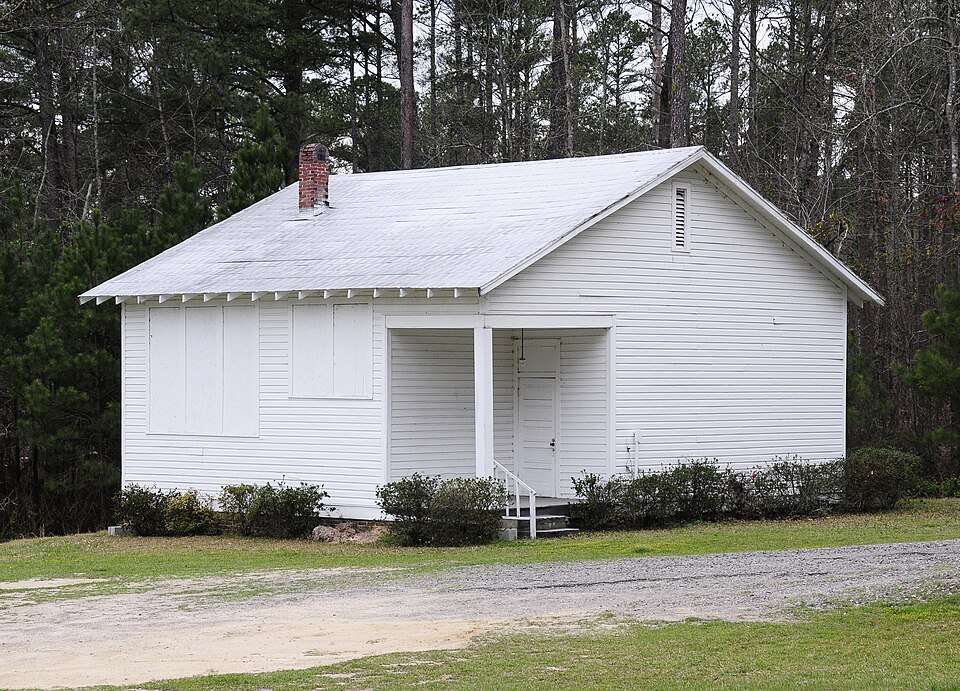
Hopewell Rosenwald School
The Hopewell Rosenwald School, located near Clarks Hill in McCormick County, South Carolina, stands as a significant testament to the educational advancements for African Americans during the era of segregation. Constructed between 1926 and 1927, this school was one of the many established through the collaborative efforts of Booker T. Washington and philanthropist Julius Rosenwald. Their initiative aimed to provide quality education to Black children in the rural South, leading to the creation of over 5,000 schools across 15 states.
Designed by architects Fletcher B. Dressler and Samuel L. Smith, the Hopewell School follows the One Teacher Community Plan, featuring two smaller classrooms and one larger room. This layout allowed for a flexible learning environment where students of various ages could receive instruction simultaneously. The building’s architectural style is rooted in the Bungalow/Craftsman tradition, characterized by its simple yet functional design.
Serving the local African American community, the school became a central hub for education, cultural activities, and social gatherings. It remained operational until 1954, when declining enrollment and the migration of families seeking better opportunities led to its closure. Despite its closure, the Hopewell Rosenwald School continued to serve the community in various capacities, reflecting its enduring legacy.
Recognizing its historical and cultural significance, the Hopewell Rosenwald School was added to the National Register of Historic Places on June 9, 2010. This designation underscores the importance of preserving such landmarks that embody the struggles and triumphs of African American education during a pivotal period in American history.
Today, the Hopewell Rosenwald School stands not only as a preserved historical site but also as a symbol of resilience and the transformative power of education in the face of adversity.