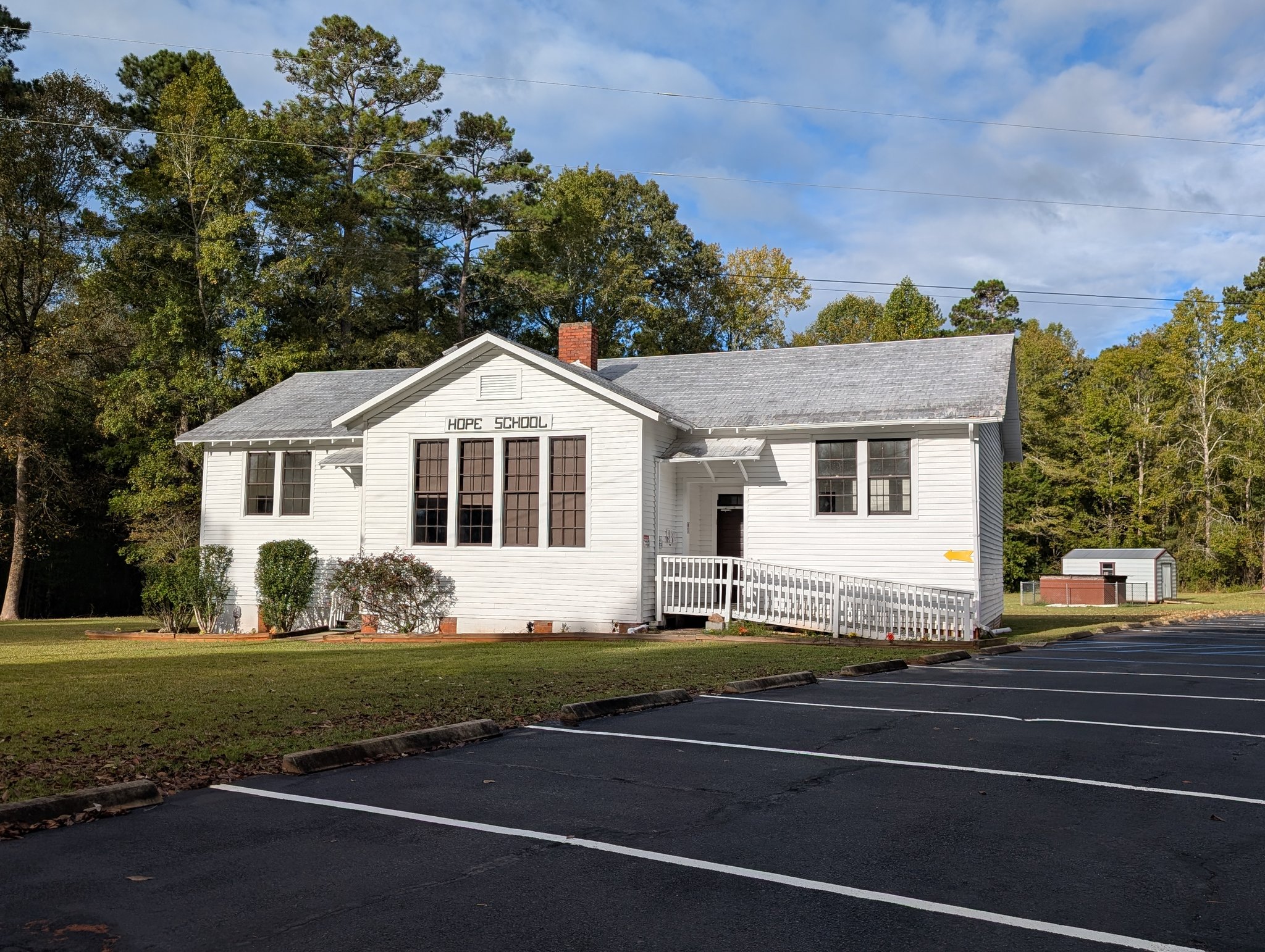
Hope Rosenwald School
The Hope Rosenwald School, located at 1971 Hope Station Road near Pomaria, South Carolina, is a poignant symbol of the early 20th-century movement to provide quality education to African American children in the rural South. Constructed in 1925–1926, the school was part of the Rosenwald School initiative, a collaboration between educator Booker T. Washington and philanthropist Julius Rosenwald. This program aimed to address the severe educational disparities faced by Black students during the era of segregation.
The Hope Rosenwald School was established on land donated by James Haskell Hope, the South Carolina Superintendent of Education from 1922 to 1945. In 1925, Hope and his family sold over two acres of land to the Newberry County School District for a nominal fee of $5. The community raised $2,200 for construction, with contributions from both African American and white residents, as well as a $700 grant from the Rosenwald Fund. The building was designed based on the Rosenwald Two-Teacher Community School Floor Plan No. 20, featuring elements of Colonial Revival architecture. It consisted of two classrooms, each accommodating multiple grade levels, and was situated adjacent to St. Paul AME Church.
The school operated until 1954, when it closed due to the consolidation of schools under the Byrnes School Equalization Program. Subsequently, the building was sold to the Jackson Community Center and Cemetery Association and was used for storage and meetings by the nearby St. Paul AME Church. In 2005, the Hope Rosenwald School was registered as a nonprofit organization, the Hope School Community Center, Inc., with a mission to serve the community through various programs. The building was listed on the National Register of Historic Places in 2007, recognizing its significance in African American education and social history in South Carolina.
Today, the Hope Rosenwald School stands as a testament to the resilience and determination of the African American community in Pomaria. Its preservation allows for reflection on the challenges and triumphs of a generation that fought for educational equity in the face of systemic racism. The school not only represents a physical structure but also embodies the collective spirit of a community committed to the advancement of its children and future generations.