Hale-Elmore-Seibels House
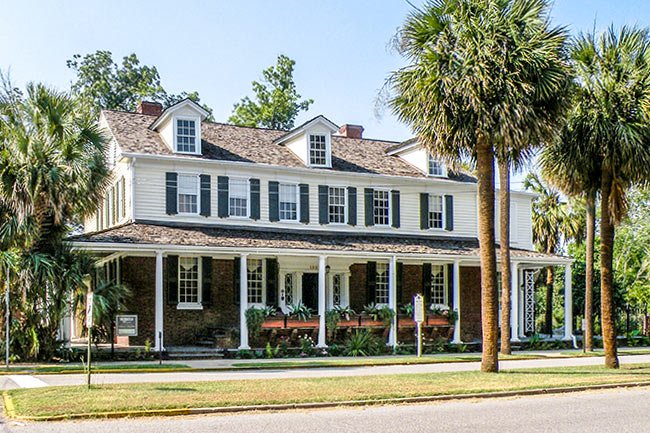
The Hale-Elmore-Seibels House, also known as the Seibels House or Picriccorn House, is one of Columbia’s most important surviving examples of late-eighteenth-century domestic architecture and is generally regarded as possibly the oldest extant house in the city. Located at 1601 Richland Street, the house was constructed by A. M. Hale on a portion of the plantation lands of Thomas Taylor, one of the founders of Columbia. Although the precise construction date cannot be established because many early records were destroyed in the burning of Columbia in 1865, the date “1796” was reportedly carved into a hand-hewn timber in the basement, providing the basis for its traditional circa 1796 date. The house was subsequently owned by Captain Benjamin Elmore and later by John Jacob Seibels, whose family acquired the property before 1860 and retained it for more than a century. Architecturally, the two-and-one-half-story dwelling reflects the Georgian tradition, with a brick first story, clapboard upper story, symmetrical massing, and carefully proportioned classical detailing. The principal entrance features a broad doorway with sidelights, while the front and west elevations are distinguished by piazzas supported by slender Doric columns.
The house retains a remarkable collection of historic architectural features that illustrate the character of an affluent Columbia residence during the city’s formative years. The first floor is characterized by large shuttered windows, while the upper story contains six windows and the roof is marked by three dormers. Original or early interior features include substantial mantelpieces and other surviving woodwork. The original piazza once extended around three sides of the dwelling; the east side was altered about 1900 with the construction of a sun porch and an additional second-floor room, while later rear additions enlarged rooms at the northeast corner. The historic property also includes significant supporting resources, including a detached kitchen constructed of handmade brick and other domestic and service dependencies that reflect the operation of the household and its associated grounds. The Hale-Elmore-Seibels House was listed in the National Register of Historic Places on May 6, 1971, under Criterion C for architecture and is locally significant as an exceptionally early and rare surviving example of Georgian residential design in Columbia. Its survival provides an important physical connection to the city’s earliest development following its founding in 1786 and makes the property an essential component of Columbia’s architectural heritage.