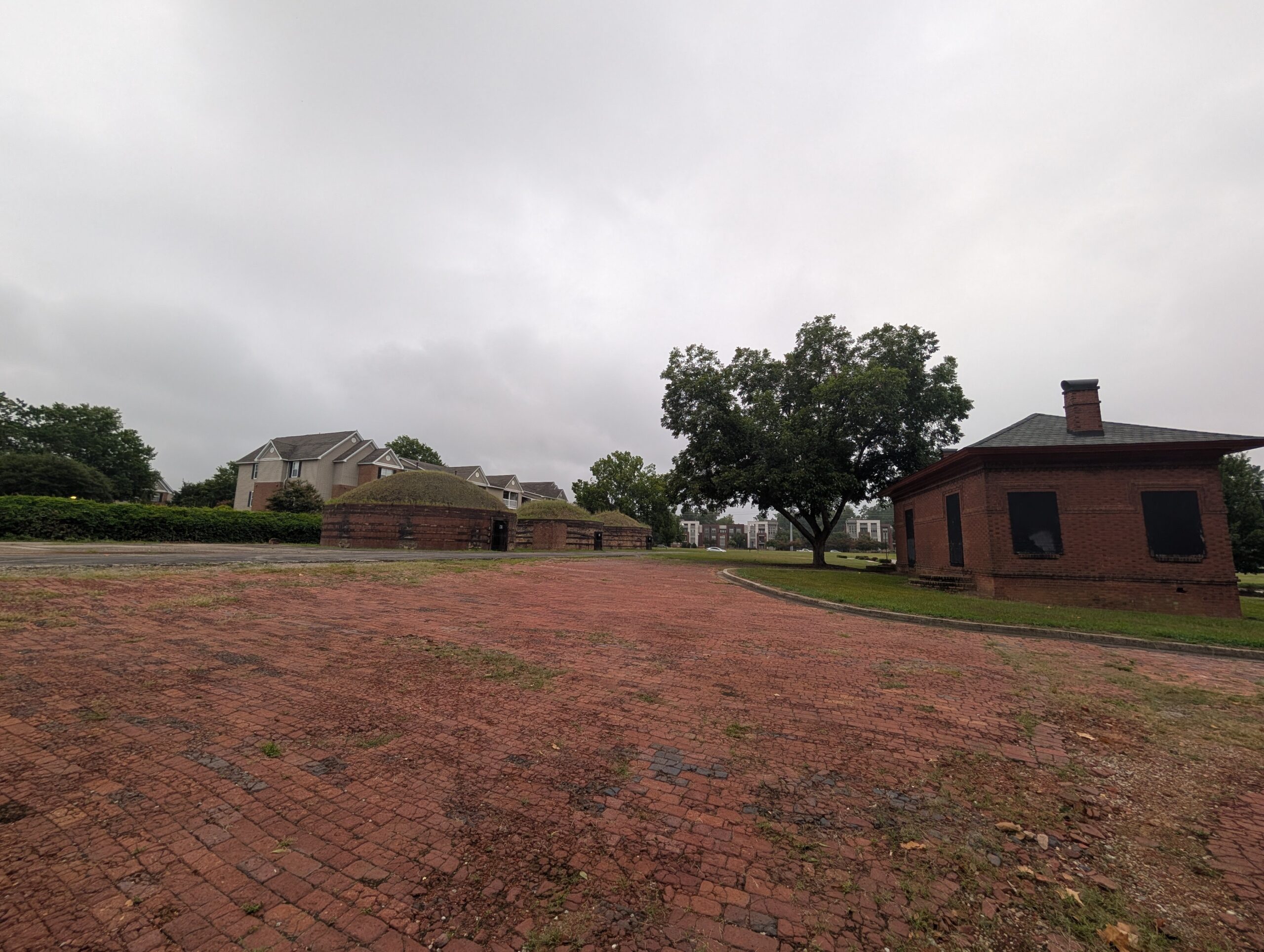
Guinard Brick Works ca 1900
Established on a site where brickmaking began as early as 1801, the Guignard Brick Works emerged as one of South Carolina’s most important industrial complexes during the early twentieth century. Although the Guignard family had manufactured brick for more than a century, the surviving complex dates primarily from around 1900 through the 1930s, when expanding construction throughout Columbia and the Midlands created an unprecedented demand for high-quality building materials. Listed in the National Register of Historic Places, the Guignard Brick Works is significant both as a remarkably intact industrial site and as a lasting symbol of the region’s commercial and manufacturing heritage.
The brick works occupies rich clay deposits along the west bank of the Congaree River, where James Sanders Guignard first established a small brick yard to supply his plantation. By the mid-nineteenth century the operation had evolved into a successful commercial enterprise, producing brick for customers throughout the region before production was interrupted by the Civil War. In 1886, Gabriel Alexander Guignard revived and modernized the business, transforming it into one of the state’s leading brick manufacturers. As Columbia experienced rapid commercial, governmental, and industrial expansion around the turn of the twentieth century, the Guignard Brick Works expanded its facilities with new kilns, rail connections, and improved manufacturing processes capable of producing millions of bricks each year.
The historic complex includes four distinctive circular beehive brick kilns, a hip-roof office building dating from approximately 1900, remnants of narrow-gauge rail lines, and other surviving industrial features that illustrate the evolution of brick manufacturing from wood-fired kilns to coal and eventually gas-fired production. Three of the surviving beehive kilns were constructed around 1920, while a fourth was rebuilt in 1932 after an earlier kiln was destroyed by fire. These impressive masonry structures represent one of the finest surviving collections of circular downdraft brick kilns in the southeastern United States and provide a rare glimpse into early twentieth-century industrial technology.
Bricks manufactured at the Guignard Brick Works were used in the construction of many of South Carolina’s most recognizable buildings, including textile mills, commercial buildings, churches, schools, government structures, and portions of the South Carolina State House. As Columbia’s skyline grew during the late nineteenth and early twentieth centuries, Guignard bricks became synonymous with quality and durability, contributing to landmarks such as Olympia Mill, Granby Mill, Richland Cotton Mill, and countless civic and residential buildings throughout the Midlands. The company’s influence extended well beyond Lexington County, helping shape the architectural character of communities across South Carolina.
Following more than 170 years of brick production, operations were relocated in 1974 to a modern manufacturing facility near U.S. Highway 1 east of Lexington, while the original riverfront site ceased industrial production. Today, the preserved office building and iconic beehive kilns stand as enduring reminders of one of South Carolina’s oldest and most successful manufacturing enterprises. The Guignard Brick Works remains an exceptionally significant industrial landmark, illustrating the technological evolution of brickmaking while commemorating the craftsmanship and entrepreneurship that helped build Columbia and much of the surrounding region during the nineteenth and twentieth centuries.