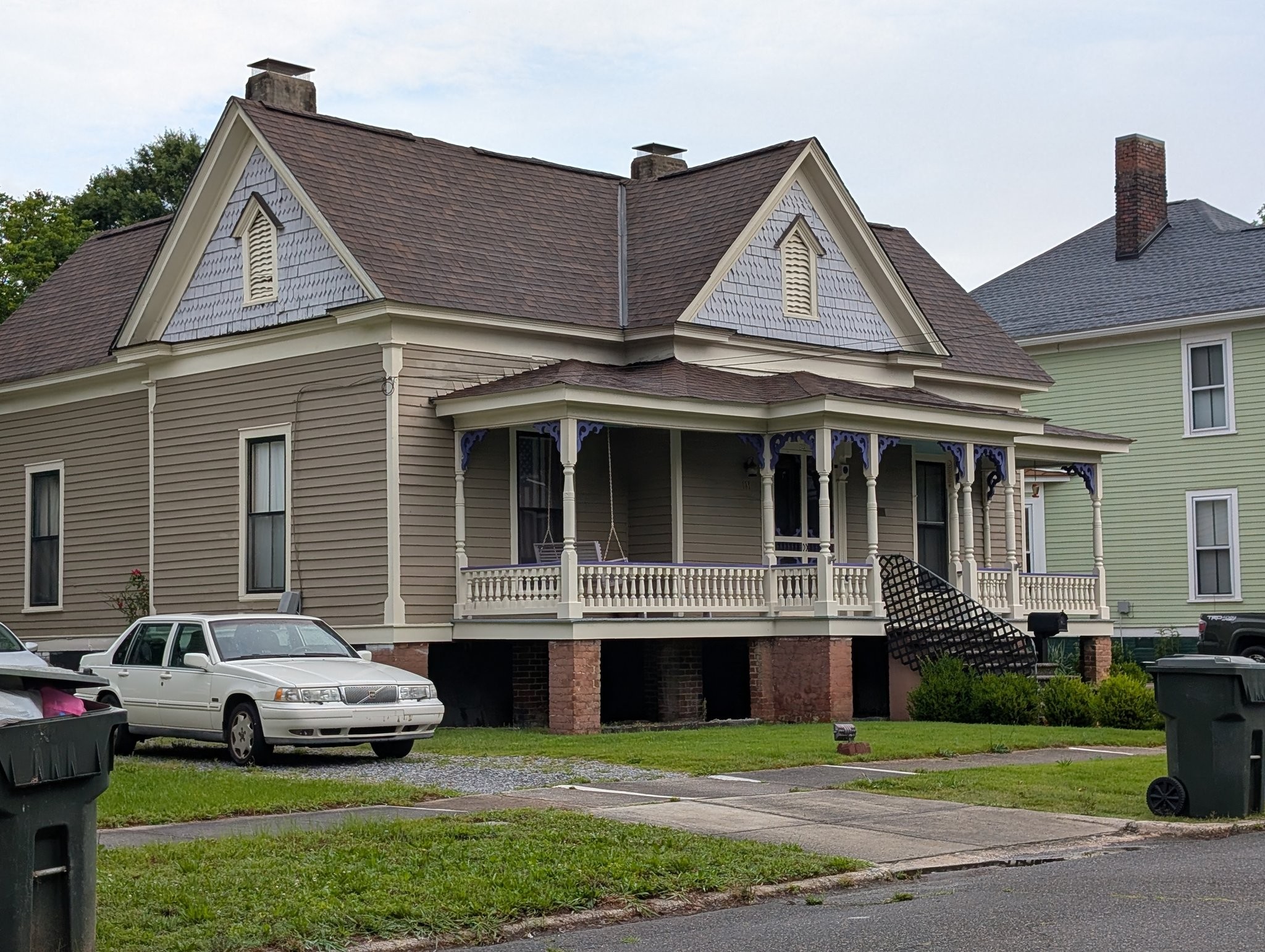
Farley B. Huey house ca 1880
Constructed around 1880, the Farley B. Huey House represents one of the surviving residential expressions of Rock Hill’s post-Reconstruction growth period, when the town was beginning its steady transformation from a small railroad stop into a more structured and economically diverse community. Built for Farley B. Huey, a member of a locally prominent family, the residence reflects the aspirations of Rock Hill’s emerging middle and upper-middle class during a time when renewed stability and expanding rail commerce were reshaping York County’s social and economic landscape.
The house stands as a product of late nineteenth-century residential design traditions, likely drawing from vernacular interpretations of the Victorian styles that were becoming increasingly common in South Carolina during this period. Homes of this era in Rock Hill often featured asymmetrical forms, modest decorative trim, and practical yet expressive detailing that balanced craftsmanship with everyday functionality. The Huey House would have conveyed both respectability and comfort, reflecting the growing desire among established families to build permanent, well-appointed residences within developing neighborhoods near the town center and transportation corridors.
The construction of the Farley B. Huey House coincided with a period of significant change in Rock Hill’s development. The arrival and expansion of the railroad had begun to stimulate commerce, encourage new settlement, and support the rise of small industries and agricultural markets tied to regional trade. Within this context, homes such as the Huey residence became important markers of stability and continuity, anchoring families who played roles in the civic and economic life of the community. These residences helped define the early residential fabric that would later evolve into Rock Hill’s historic neighborhoods.
Over time, the Farley B. Huey House has come to represent the architectural and historical character of Rock Hill’s late nineteenth-century domestic life. As one of the period’s surviving structures, it offers insight into the construction methods, stylistic preferences, and social dynamics of a community in transition. The house remains a tangible link to the formative decades of Rock Hill’s development, reflecting the values of permanence, respectability, and growth that shaped the city’s early identity.