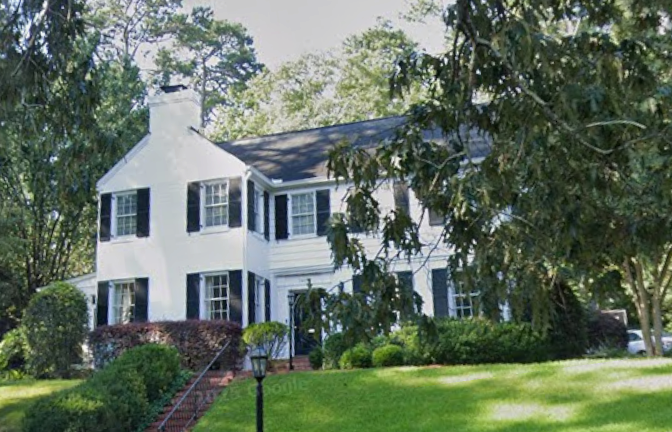
Ernest Graham House ca 1937
The Ernest Graham House, dating to circa 1937, is a representative example of the refined residential architecture that emerged in Columbia during the late 1930s, reflecting the city’s continued growth and the popularity of modern interpretations of traditional American domestic styles. The house exhibits the restrained character associated with the period, emphasizing balanced proportions, a carefully composed façade, and practical planning rather than the elaborate ornamentation of earlier decades. Its design reflects the influence of the Colonial Revival and related early-twentieth-century residential traditions, while its simplified detailing and overall massing convey the transition toward the more streamlined architectural vocabulary of the pre-World War II era. Set within a residential landscape characteristic of established Columbia neighborhoods, the property contributes to an understanding of the architectural development and changing domestic preferences of the city during the 1930s.
Historically, the Ernest Graham House is significant as part of the residential development of Columbia during a period when the city was expanding beyond its nineteenth-century core and established neighborhoods were being developed with substantial single-family residences. The house illustrates the aspirations and lifestyles of Columbia’s professional and middle- to upper-middle-class residents during the interwar period, when well-designed homes increasingly incorporated modern conveniences while retaining familiar traditional forms. Its circa 1937 construction places it within an important transitional period in American architecture, when traditional styles were being adapted to changing construction practices, technologies, and patterns of domestic life. Through its architectural character, scale, and setting, the Ernest Graham House helps document the evolution of Columbia’s residential architecture and the broader transformation of the city’s built environment during the years immediately preceding World War II.