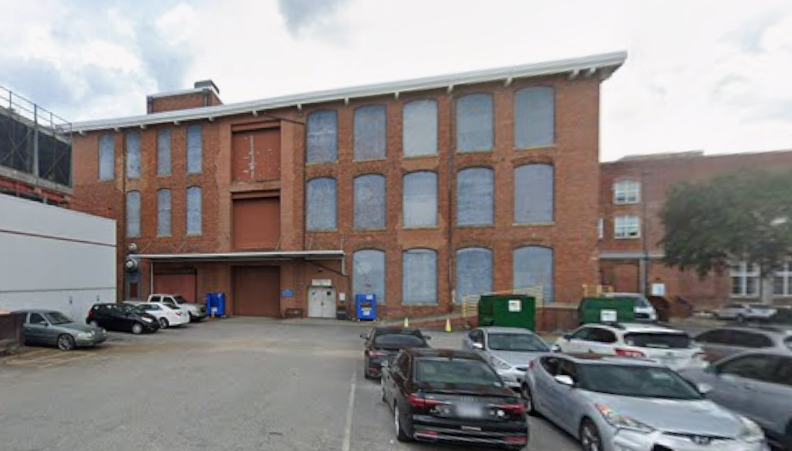
Columbia Mills Building ca 1893
The Columbia Mills Building, dating to approximately 1893, represents an important chapter in Columbia’s industrial and economic history and reflects the city’s emergence as a significant textile manufacturing center in the late nineteenth century. Constructed during a period of rapid industrial growth across the South, the building was associated with the development of Columbia Mills and the expansion of cotton manufacturing along the Congaree River. Its history illustrates the transformation of Columbia from a primarily governmental and commercial community into a city increasingly shaped by factories, railroads, technology, and industrial labor.
The Columbia Mills enterprise was closely connected to the abundant cotton production of South Carolina and the growing availability of regional transportation. Columbia’s location at the fall line of the Congaree River provided access to waterpower, while expanding railroad connections allowed raw cotton, machinery, fuel, and finished textiles to move efficiently between the mill and outside markets. These advantages encouraged the development of large-scale manufacturing and helped establish Columbia as an important center of the New South industrial economy.
Architecturally, the Columbia Mills Building reflected the practical requirements of late nineteenth-century textile production. Industrial buildings of the period generally emphasized strong masonry construction, large open floor areas, high ceilings, extensive windows for natural illumination and ventilation, and durable structural systems capable of supporting heavy machinery. The building’s industrial character was therefore determined as much by function as by architectural appearance. Its design illustrates the emerging factory architecture of the Gilded Age, when advances in engineering allowed manufacturers to construct increasingly large and specialized industrial facilities.
The Columbia Mills complex was especially important because of its relationship to the development of electricity and modern industrial technology. The exploitation of the Congaree River represented an early example of the South’s effort to convert natural resources into industrial power. The mill became associated with the production of electric power for textile manufacturing, demonstrating how Southern communities were beginning to embrace new technologies that would reshape manufacturing, transportation, communications, and everyday life.
The mill also provides an important window into the social history of Columbia. Textile factories created employment for large numbers of workers and encouraged the development of neighborhoods, commercial establishments, churches, schools, and other institutions serving mill families. The rise of the textile industry therefore affected much more than the factory itself; it helped create a new industrial community and altered patterns of work and daily life. Workers experienced the demanding schedules, occupational routines, and close-knit social relationships that became characteristic of Southern mill communities.
The Columbia Mills Building further illustrates the economic philosophy of the New South era. Following the Civil War, Southern leaders and businessmen promoted manufacturing and diversification as a means of reducing the region’s dependence upon agriculture. Textile production became one of the most successful expressions of this movement. Columbia Mills stood as a visible symbol of the belief that South Carolina could use its cotton resources, waterpower, transportation network, and labor force to build a modern industrial economy.
The building’s circa-1893 date places it within a particularly significant period of Columbia’s development. The city was experiencing population growth, expanding transportation networks, new commercial construction, and increasing industrial investment. The Columbia Mills Building was part of this transformation and helped establish the industrial landscape that would remain an important component of the city for generations.
The Columbia Mills Building is therefore significant for its architectural, industrial, technological, and social associations. It represents the rise of textile manufacturing in Columbia, the exploitation of the Congaree River for industrial power, and the broader New South effort to modernize the Southern economy. As a surviving reminder of Columbia’s late nineteenth-century industrial expansion, the property helps tell the story of the workers, entrepreneurs, engineers, and communities whose efforts transformed the capital into a modern industrial city.