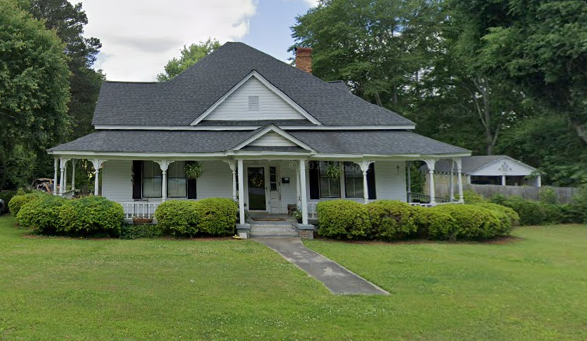
Coates House in Newberry
The Coates House in Newberry is a distinguished example of late 19th- to early 20th-century residential architecture, reflecting both the craftsmanship of its builders and the aspirations of the town’s rising professional class. Positioned prominently within Newberry’s historic streetscape, the house combines a measured elegance with the ornamental flourishes characteristic of its period, making it a meaningful part of the town’s architectural heritage.
The residence’s two-story frame is anchored by a steeply pitched roof and a projecting front gable, features that lend both verticality and visual interest to the façade. A broad, inviting front porch stretches across the entrance, supported by turned wooden posts and adorned with delicate balustrades and decorative brackets, creating a space that blends social function with aesthetic charm. Tall, narrow sash windows punctuate the walls, allowing light to filter gracefully into the interior while reinforcing the structure’s balanced proportions.
Detailing on the Coates House demonstrates a careful attention to texture and rhythm. From the bracketed eaves to the patterned wood trim on the gables, the ornamental elements are applied with restraint, emphasizing refinement over extravagance. Inside, the layout would have accommodated both formal entertaining and family life, with high ceilings, spacious rooms, and fine wood finishes enhancing the home’s sense of warmth and dignity.
Historically, the Coates House is linked to families who contributed to the civic and economic life of Newberry, anchoring the residence not only as a private home but as a witness to the town’s evolving identity. Its preservation allows contemporary viewers to appreciate how Newberry’s residents expressed social status, taste, and craftsmanship through domestic architecture.
Today, the Coates House stands as a testament to the elegance and endurance of Newberry’s built heritage. Its gables, porch, and finely detailed woodwork continue to convey the care and pride of its original builders, while its presence within the town’s historic fabric offers a tangible connection to the people and stories that shaped Newberry’s architectural and social landscape.