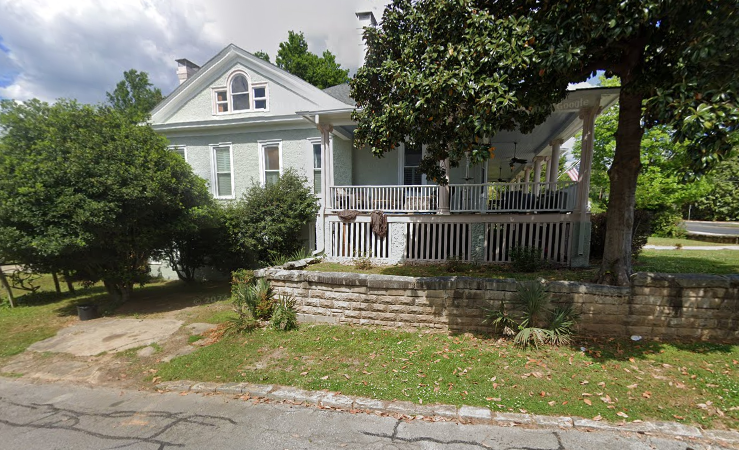
Charles Purcell House in Newberry
The Charles Purcell House in Newberry is a striking example of the town’s rich domestic heritage, embodying the elegance and craftsmanship of the late 19th century while reflecting the aspirations of a community coming into its own. Built for Charles Purcell, a prominent local figure, the house carries both architectural distinction and historical resonance, making it an enduring part of Newberry’s cultural landscape.
The residence presents a confident façade, its frame construction enriched with the decorative vocabulary of the Victorian era. A prominent gabled roofline, bracketed eaves, and tall sash windows give the structure both stature and rhythm. The broad front porch, supported by turned posts and adorned with delicate trim, creates a welcoming threshold — a space where family and community life met, and where architectural ornament served to elevate the everyday.
What makes the Charles Purcell House particularly notable is the balance it strikes between ornament and proportion. While the Victorian taste for detail is clearly present in its woodwork and trim, the overall form remains disciplined and harmonious, revealing a household that valued refinement as much as comfort. Inside, the high ceilings, polished wood finishes, and orderly room arrangement would have provided both a gracious setting for entertaining and the warmth of family life.
Beyond its architecture, the house tells a story of continuity and identity. Charles Purcell and his family were woven into the civic and professional life of Newberry, and their home became part of the town’s social fabric. In this way, the dwelling is not merely a structure of wood and brick, but a vessel of memory — a reminder of the individuals and families whose lives shaped the community.
Today, the Charles Purcell House endures as a vital piece of Newberry’s architectural heritage. Its porch, gables, and careful detailing stand as a tribute to the craftsmanship of its era, while its presence within the historic fabric of the town reminds us of the deep connections between architecture, family, and community in South Carolina’s upcountry.