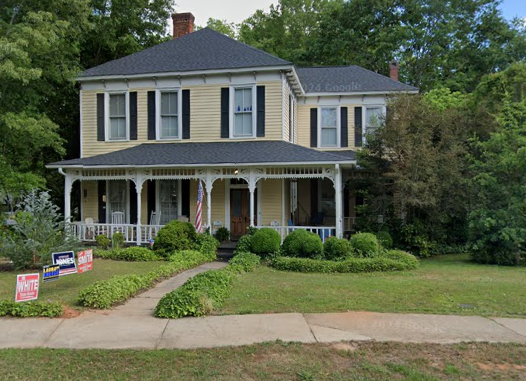
Chappel House in Newberry
The Chappel House in Newberry stands as a graceful reflection of the town’s architectural and cultural development during the late 19th century, a time when prosperity and civic pride found expression in finely built homes. Set among other distinguished residences, the house presents a dignified presence, blending Victorian-era design with elements of classical restraint, a combination that gives it both charm and quiet authority.
Its frame construction, sheathed in weatherboard, is enlivened by a front-facing gable and broad porch that creates a welcoming threshold. The porch, supported by turned wooden posts and accented with decorative brackets, is typical of the period’s taste for ornament while also serving as a shaded gathering place in the warm South Carolina climate. Tall, narrow sash windows punctuate the façade, their rhythm lending elegance to the structure while ensuring that its interior rooms were filled with light and air.
The overall form of the Chappel House balances symmetry with picturesque detail. A gabled roofline and modest decorative trim add texture without overwhelming the building’s proportions, allowing it to read as both practical and stylish. Such houses spoke to the aspirations of Newberry’s professional class, who desired homes that demonstrated refinement while remaining rooted in the realities of Southern small-town life.
Historically, the Chappel House is tied to families who contributed to Newberry’s civic and social story, their home serving as both a private retreat and a setting for community engagement. It embodies the continuity of family and town, linking personal memory to a broader narrative of growth, resilience, and identity.
Today, the Chappel House endures as part of Newberry’s architectural heritage, its porch, gables, and thoughtful detailing reminding us of an era when craftsmanship and community were woven into the very fabric of domestic architecture. It stands not only as a residence, but as a touchstone of Newberry’s historic landscape, carrying forward the character and grace of the town’s built past.