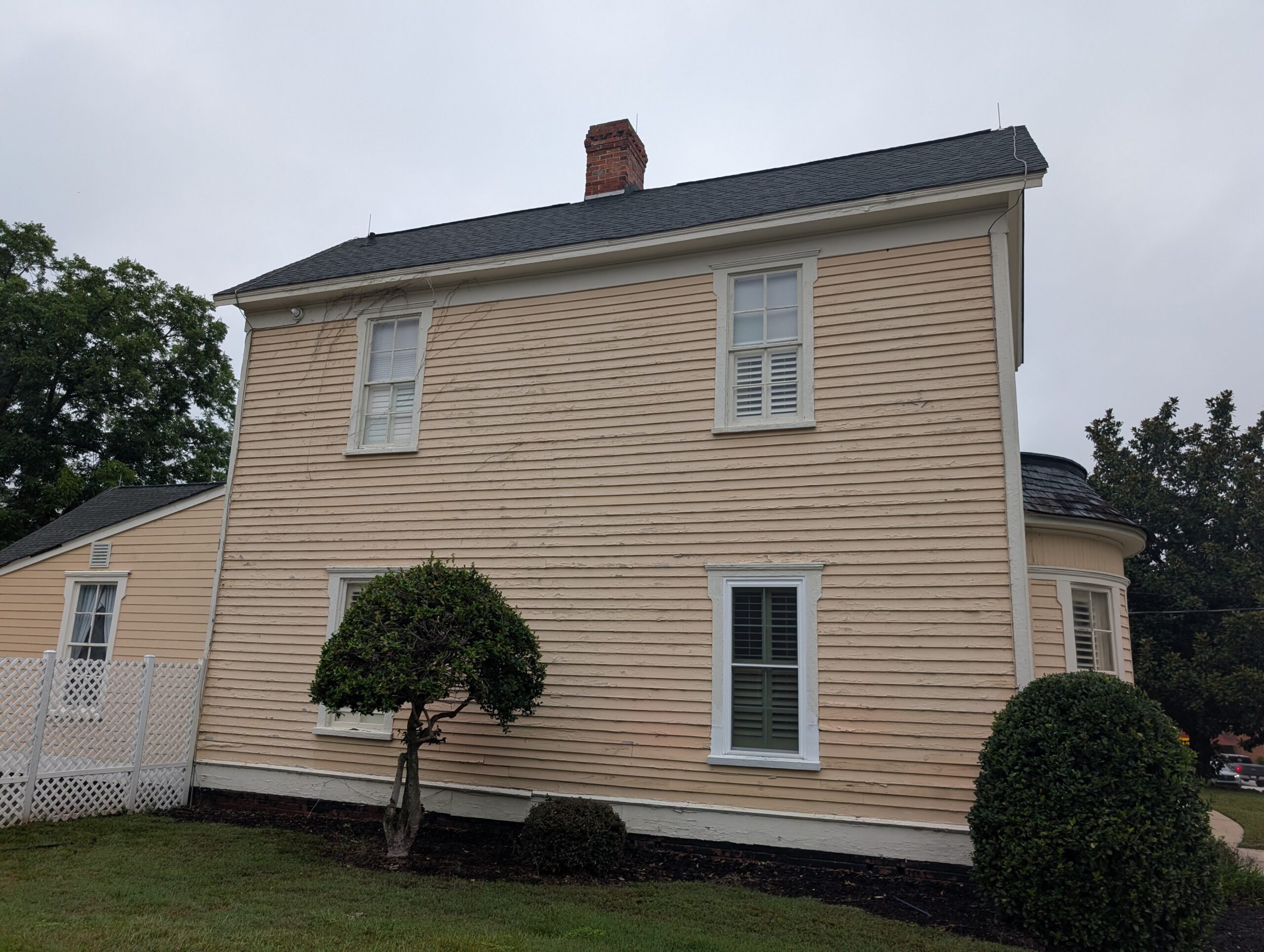
CE Corley house ca 1895
Constructed around 1895, the C.E. Corley House stands as one of Lexington’s finest surviving examples of late Victorian residential architecture, displaying the picturesque massing and decorative detailing associated with the Queen Anne style. Built by prominent local builder, farmer, and public official Charles Edward Corley (1866–1943), the residence reflects both the craftsmanship and prosperity that characterized Lexington during the closing years of the nineteenth century. The home was listed in the National Register of Historic Places in 1983 in recognition of its architectural significance and its association with one of Lexington County’s most influential builders.
The two-story weatherboard dwelling is organized around an L-shaped plan with a rear ell beneath intersecting gable roofs. Its most striking feature is the elaborate wraparound porch tucked into the angle of the “L,” where a projecting gabled entrance joins an unusual gazebo capped by a conical wood-shingled roof. Turned porch posts, decorative brackets, spindlework balustrades, corbeled brick chimneys, a semicircular bay window, scalloped gable trim, and broad baseboards showcase the ornamental woodwork that defines the Queen Anne style. Interior spaces retain handsome period detailing, including decorative moldings, wainscoting, and original wood finishes that illustrate the quality of Corley’s craftsmanship.
Charles Edward Corley was among Lexington County’s most accomplished builders, responsible for constructing numerous landmark buildings throughout the community, including churches, commercial buildings, residences, and textile-related structures. Beyond his building career, he served the county as supervisor from 1912 to 1920 and later as magistrate, making his home an important reminder of both Lexington’s architectural heritage and its civic leadership during a period of rapid growth.
The property also includes three contributing historic outbuildings a smokehouse, woodshed, and tenant house that survive from the property’s early years and help illustrate the functioning of a prosperous rural-town household at the turn of the twentieth century. Together, the residence and its ancillary buildings form one of Lexington’s most complete and well-preserved historic domestic complexes. Today, the C.E. Corley House remains an architectural landmark whose distinctive silhouette, ornate porch, and exceptional craftsmanship continue to represent the elegance and prosperity of Lexington’s Victorian era.