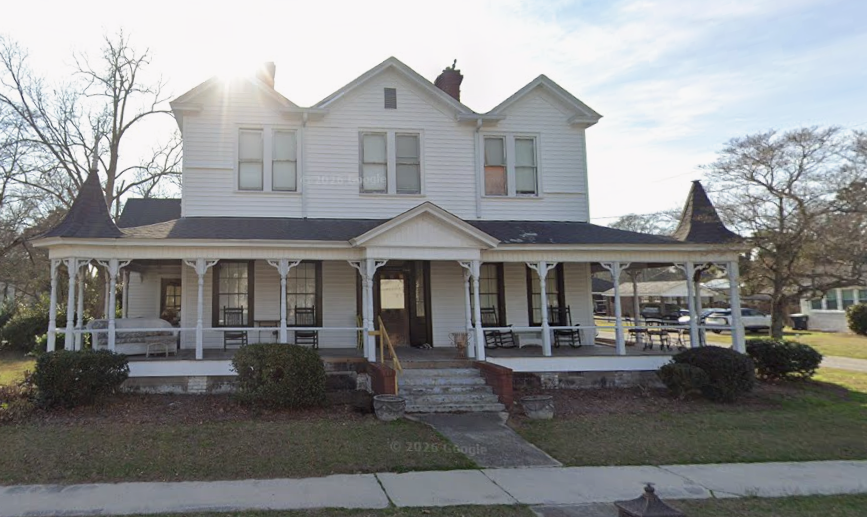
CD Barr House ca 1909
Constructed circa 1909, the C. D. Barr House is a distinguished example of early twentieth-century residential architecture in Batesburg-Leesville, reflecting the prosperity and optimism that accompanied the community’s rapid commercial and agricultural expansion during the first decade of the twentieth century. Built for C. D. Barr, a prominent local businessman and civic leader, the residence illustrates the success enjoyed by many of the town’s merchants and professionals as the railroad, cotton industry, and expanding local commerce transformed Batesburg-Leesville into one of the principal trade centers of the South Carolina Midlands. The house remains an enduring symbol of the community’s growth and the confidence that characterized this period of economic progress.
Architecturally, the C. D. Barr House exhibits the transitional design influences popular during the era, incorporating elements of the Colonial Revival and Craftsman styles into a spacious and elegantly proportioned frame residence. The dwelling is distinguished by its symmetrical façade, broad hipped roof with projecting gables, and expansive wraparound porch that provides both architectural balance and functional outdoor living space. Substantial porch columns resting on brick piers, wide overhanging eaves, decorative brackets, and carefully crafted wood trim demonstrate the quality workmanship of local builders. Large double-hung windows provide generous natural light to the interior while reinforcing the home’s balanced appearance, and the thoughtfully arranged floor plan reflects the increasing emphasis on comfort and modern domestic living during the early twentieth century.
Occupying a prominent residential setting, the C. D. Barr House contributes significantly to the historic streetscape of Batesburg-Leesville. Its scale, craftsmanship, and architectural detailing complement neighboring historic residences that collectively document the town’s evolution from a rural railroad junction into a prosperous commercial community. The residence retains the character and materials that convey its historic significance while serving as an important reminder of the architectural refinement achieved during the community’s most active period of residential development.
Today, the C. D. Barr House continues to represent an important chapter in the history of Batesburg-Leesville. Through its well-preserved architecture and its association with one of the community’s early civic and business leaders, the residence embodies the prosperity, craftsmanship, and community pride that defined the town during the opening years of the twentieth century, making it a valuable contributor to the area’s historic and architectural heritage.