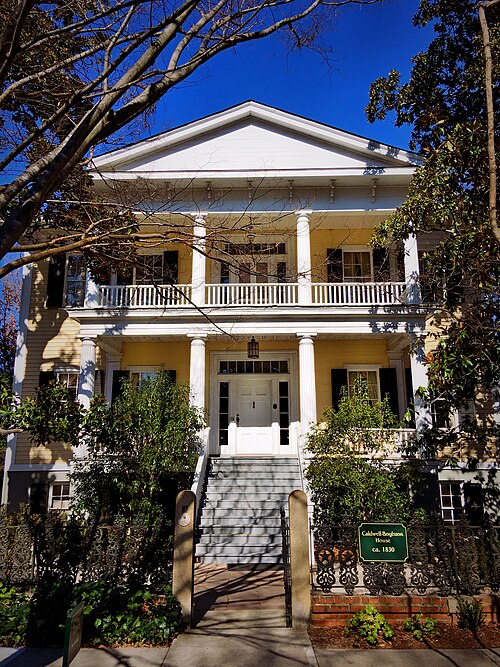
Caldwell-Hampton-Boylston House, ca. 1869 — Columbia, South Carolina. Although the property is often associated with its 1869 purchase by Daniel H. Chamberlain, the Caldwell-Hampton-Boylston House itself is considerably earlier, having been constructed about 1830 by John Caldwell, a prominent Columbia merchant and president of the South Carolina Railroad. Located at 829 Richland Street on Arsenal Hill, the three-story, five-bay frame residence is one of Columbia’s finest surviving examples of Greek Revival domestic architecture. Its clapboarded exterior is organized around a monumental two-story, double-tiered front porch supported by four substantial Doric columns, with simple balustrades at each level. Twin interior chimneys rise through the steeply pitched roof, while the restrained symmetry, classical proportions, and broad porch give the house the dignified appearance characteristic of an antebellum urban mansion. The property also retains historic landscape features, including ironwork and brick fencing dating from about 1855, as well as a stable/carriage house and garden structures.
The house possesses an unusually rich political and social history. In 1869 it was purchased by Daniel H. Chamberlain, who later served as South Carolina’s Reconstruction-era governor from 1874 to 1876 and occupied the residence during his administration. The property was also associated with the Hampton family, including Lucy and Caroline Hampton, nieces of General Wade Hampton, before entering a long period of association with Sarah Porter Boylston, who occupied the house for more than five decades and developed its gardens into an important Columbia horticultural landmark. Formal plantings, boxwoods, camellias, azaleas, dogwoods, shady arbors, statuary, and garden rooms evolved over the nineteenth and early twentieth centuries, making the landscape an important complement to the architecture. The Caldwell-Hampton-Boylston House was listed in the National Register of Historic Places in 1971 and remains an important component of Columbia Historic District I and the Governor’s Mansion complex, illustrating the city’s antebellum architectural character as well as its political and social history.