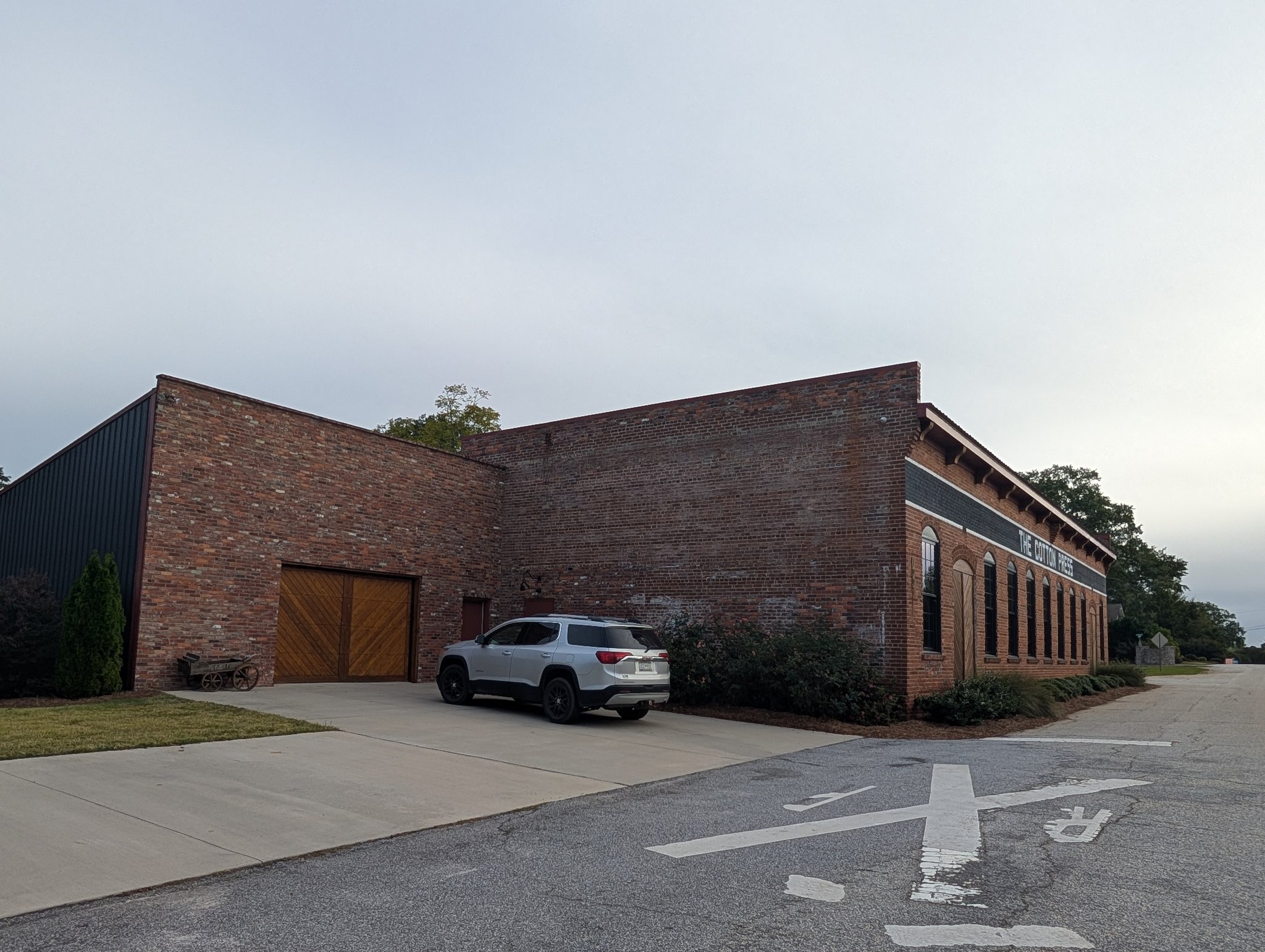
Caldwell Contractors Building in Little Mountain
The Caldwell Contractors Building in Little Mountain reads like a short chapter of the town’s industrial story — a sturdy, workmanlike presence that records a shift from rural processing to community reuse. Erected in the early 20th century (c. 1904), the brick block is most often identified in local inventories and photographs as the former Little Mountain Oil & Fertilizer Company building; its surviving shell and a faded painted advertisement on the wall still hint at the commerce that once pulsed through its doors.
Originally commissioned as a processing plant for cottonseed oil and related agricultural products, the building was a significant local investment — built by contractor D.A. Tompkins for J.C. Epting at a reported cost of roughly $35,000, a large sum for the period — and its scale and construction reflect that industrial purpose. Its massing and fenestration were designed around practical needs: accommodating heavy machinery, receiving rail- or wagon-borne goods, and allowing light and ventilation for workers and processing rooms. Those industrial design choices are what give the building its authentic, early-20th-century character.
Over time the structure became associated with Caldwell Contractors (hence the familiar name used in town inventories and on the National Register listing for the Little Mountain Historic District), serving as a warehouse and local business premises; more recently the property has been part of adaptive-reuse conversations — an example of how these old industrial shells can be repurposed for community-facing uses such as event space or small business venues. The building therefore functions on two heritage levels: as a surviving artifact of Little Mountain’s agricultural-industrial era and as a candidate for tasteful reuse that keeps the town’s streetscape lively.
Architecturally, the Caldwell Contractors Building is best appreciated for its honest, utilitarian aesthetics: straightforward brickwork, large openings that read as former loading bays, and the weathered painted signage that layers local commercial memory onto the façade. These elements make it a quiet but powerful anchor for the Little Mountain Historic District — less about ornament and more about the rhythms of work, transport, and local trade that shaped the town. Preserving and celebrating buildings like this keeps Little Mountain’s industrial past legible while offering flexible spaces for its future.