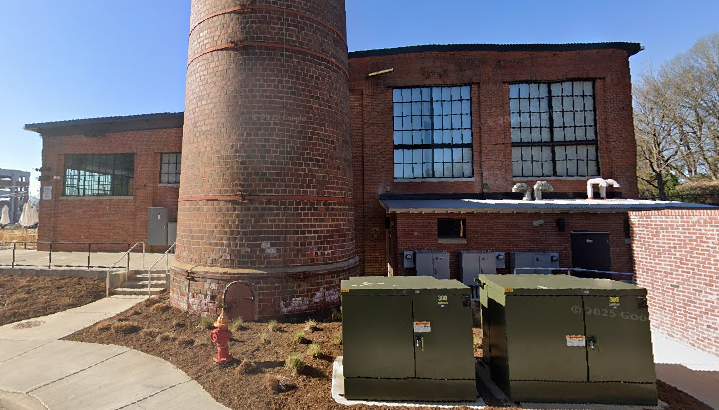
The Bleachery Water Treatment Plant, constructed in 1930 on Stewart Avenue in Rock Hill, represented a critical piece of infrastructure in one of the most significant industrial developments in the city’s history. Built to serve the newly established Rock Hill Printing and Finishing Company—known locally as “The Bleachery”—the facility was made possible through a municipal bond issue approved by Rock Hill citizens to provide the enormous quantities of clean water required for textile finishing operations. Water was drawn from the Catawba River through an extensive intake and transmission system, then treated at the plant before being distributed throughout the rapidly expanding industrial complex and the growing city.
Architecturally, the one-story brick facility was designed in the Colonial Revival style, an uncommon but noteworthy choice for an industrial utility building. The structure featured a symmetrical façade, cross-gabled roof, decorative parapets, cast-stone entrance detailing, large steel industrial windows, and exposed decorative rafter tails that elevated the building beyond purely utilitarian design. Surrounding the building were a series of above-ground and underground filtration and purification basins that formed an integrated treatment system, demonstrating the increasingly sophisticated engineering standards of the early twentieth century.
The plant played an indispensable role in supporting the Rock Hill Printing and Finishing Company, one of the largest textile finishing operations in the South. Opened during the early years of the Great Depression, the Bleachery became a major economic engine for Rock Hill, eventually employing thousands of workers and helping establish the city as a leading textile manufacturing center. The water treatment facility was essential to this success, providing the vast quantities of purified water required for bleaching, dyeing, printing, and finishing cloth.
Recognized for both its architectural character and its association with Rock Hill’s textile heritage, the Bleachery Water Treatment Plant was individually listed in the National Register of Historic Places in 2008. It was cited as a significant example of Colonial Revival industrial architecture and as an important component of the city’s textile development during the twentieth century. Although the facility was later demolished in 2019, it remains an important chapter in the story of Rock Hill’s industrial growth and the enduring legacy of the Bleachery complex.