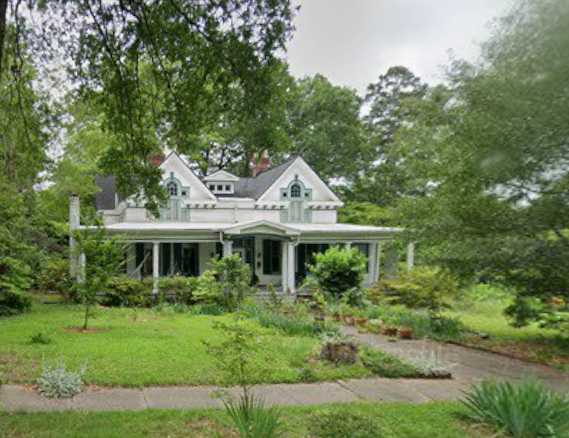
The Bays-Blackman House, constructed circa 1906 in Rock Hill, represents the city’s rapid residential and economic growth during the early twentieth century, when prosperous merchants, professionals, and civic leaders established substantial homes in developing neighborhoods surrounding the downtown business district. Built during a period of expanding textile production and commercial activity, the residence reflects the optimism and permanence associated with Rock Hill’s emergence as one of the leading communities in the South Carolina Piedmont.
Architecturally, the house embodies the transitional design trends popular during the first decade of the twentieth century, blending late Victorian influences with the increasingly fashionable Colonial Revival style. The residence is characterized by its balanced proportions, prominent porch, decorative woodwork, and complex roofline, features that conveyed both refinement and social standing. Historic residential architecture of this era emphasized craftsmanship and ornamentation while gradually adopting the more symmetrical forms and classical detailing that would dominate American domestic architecture in the decades that followed.
The Bays-Blackman House gained significance through its association with prominent local families whose business and civic activities contributed to Rock Hill’s development during a transformative period in the city’s history. Homes of this scale and character illustrated the rising prosperity of Rock Hill’s middle and upper-middle classes as industrial expansion generated new commercial opportunities and reshaped the social landscape of the community. The residence also contributed to the architectural cohesiveness of one of Rock Hill’s established historic neighborhoods, where many of the city’s most distinguished early twentieth-century homes remain concentrated.
Today, the Bays-Blackman House stands as an important surviving example of Rock Hill’s residential heritage and architectural evolution during the early 1900s. Its preservation helps maintain the historic character of the city’s older neighborhoods while offering insight into the lifestyles, aspirations, and craftsmanship associated with Rock Hill’s formative years of growth and modernization.