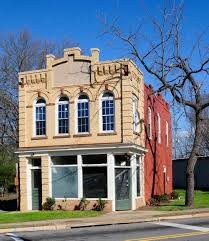
Afro-American Insurance building ca 1909
Constructed circa 1909, the Afro-American Insurance Company Building stands as one of Rock Hill’s most important surviving landmarks associated with the city’s early African American business community. Located along South Dave Lyle Boulevard within the historic African American commercial district, the two-story brick building was erected to house the local office of the Afro-American Insurance Company, a black-owned firm that operated throughout the Southeast and provided financial services to African American communities during an era when such opportunities were often limited by segregation and discrimination. The building served as a powerful symbol of economic self-sufficiency, entrepreneurship, and professional advancement within Rock Hill’s emerging African American middle class.
Designed and built by William W. Smith of Charlotte, North Carolina, one of the region’s most notable African American designers and builders, the structure reflects the Commercial Style influences popular during the early twentieth century. Its distinctive appearance is characterized by a tan brick façade contrasted with red brick side walls, decorative brick quoining, a corbelled cornice, and a prominent parapet. These architectural features, combined with Smith’s skilled masonry craftsmanship, helped create a building that conveyed permanence, stability, and civic pride. The structure shares design elements found in several of Smith’s other important works throughout the Carolinas and remains one of the finest examples of his surviving commercial architecture.
Beyond its role as an insurance office, the building became a center of African American commerce, housing a succession of black-owned businesses including grocery stores, restaurants, and seafood markets throughout the twentieth century. Because much of Rock Hill’s historic African American business district was lost during urban renewal and redevelopment projects, the Afro-American Insurance Company Building has gained exceptional significance as perhaps the most important surviving commercial structure associated with the city’s early Black business community. Recognized for both its architectural and cultural importance, the building was listed in the National Register of Historic Places in 1992 and continues to stand as a lasting testament to the entrepreneurial spirit and resilience of Rock Hill’s African American citizens.