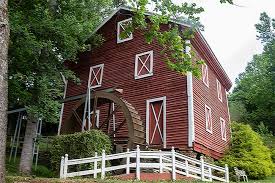
Ballenger Mill
Ballenger Mill emerged along a quiet Upstate watercourse as one of the region’s early rural engines of livelihood, a place where practical necessity and local craftsmanship shaped both its history and architecture. Established during the 19th century, the mill served nearby farming families who depended on a trusted location to grind corn, wheat, and feed. Like so many mills of the Carolina foothills, it became a natural gathering point—part workplace, part community crossroads—where the sound of flowing water blended with conversations, trade, and the shared routines of agrarian life.
Architecturally, Ballenger Mill reflected the straightforward, enduring traditions of vernacular mill construction. Its form likely followed a rectangular, timber-frame plan anchored by heavy sills and stone footings. Weatherboard siding wrapped the exterior, offering protection against humidity and seasonal storms, while a steep gabled roof shed rain toward the creek that powered its machinery. The openness of the interior—designed for millstones, grain chutes, and gearing—spoke to the purely functional nature of the building, where every beam, brace, and pulley served a purpose.
The heart of the mill was its waterpower system, which may have included a hand-dug millrace or a wooden flume channeling water from the nearby stream to the wheel. Whether turning an overshot or undershot wheel, the controlled flow converted natural energy into mechanical force, driving the millstones that shaped daily life for the farmers who relied on them. The rhythmic motion of wooden shafts and iron fittings created a constant hum within the structure—a mechanical heartbeat sustained by the landscape around it.
Over time, as agricultural methods shifted and industrial milling became centralized elsewhere, Ballenger Mill gradually quieted, its workings slowing and eventually ceasing. Yet the building—and the memory of its service—remained woven into the identity of the surrounding community. Its weathered frame and surviving foundations stand as reminders of a time when water powered enterprise, neighbors depended on one another, and craftsmanship defined the built environment.
Today, Ballenger Mill survives not only as a relic of early rural industry but also as an architectural artifact that reveals how ingenuity, natural resources, and community needs shaped the Upstate’s historic landscape.