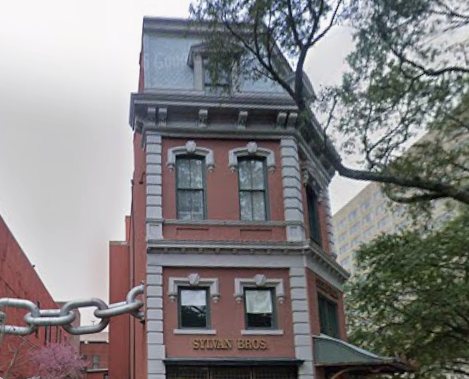
Sylvan Building ca 1871
The Sylvan Building, constructed about 1871, is an important surviving example of Columbia’s post-Civil War commercial architecture and an early landmark in the rebuilding of the city’s downtown. Located on Main Street, the building belongs to the period immediately following the devastating Union occupation and burning of Columbia in February 1865, when much of the city’s commercial core had to be reconstructed. Its construction reflects the determination of Columbia’s merchants and property owners to restore Main Street as the city’s principal center of trade and business during the difficult years of Reconstruction.
Architecturally, the Sylvan Building represents the Italianate commercial tradition that remained popular throughout the South during the middle and late nineteenth century. The design emphasizes a simple rectangular commercial block enlivened by carefully arranged openings and ornamental details. Its masonry construction and relatively substantial scale reflect the increasing permanence of Columbia’s rebuilt business district, while the restrained ornamentation is characteristic of commercial buildings intended to accommodate stores and offices rather than residential use.
The building’s façade is organized in a traditional nineteenth-century commercial manner, with a street-level storefront providing direct access to businesses and upper-story windows illuminating offices or other commercial spaces. The arrangement demonstrates the practical vertical organization that became increasingly common in urban commercial architecture: retail activity occupied the ground floor while professional, mercantile, or office uses could be accommodated above. This arrangement allowed a relatively narrow downtown lot to support several complementary functions.
The Sylvan Building is particularly important because of its Reconstruction-era context. Columbia’s commercial district underwent substantial rebuilding during the years after 1865, and new buildings such as the Sylvan Building helped replace the structures destroyed during the Civil War. By the early 1870s, merchants were once again investing in permanent brick and masonry buildings along Main Street, signaling the city’s gradual economic recovery. The Sylvan Building therefore provides a tangible architectural connection to one of the most transformative periods in Columbia’s history.
The building also reflects the changing character of Main Street during the late nineteenth century. Columbia was emerging from the destruction and economic disruption of the Civil War and gradually reestablishing itself as a regional center for commerce, government, transportation, and professional services. Main Street became increasingly lined with two- and three-story commercial structures, creating the dense urban streetscape that distinguished the city’s business district. The Sylvan Building formed part of this evolving commercial environment.
Its survival is particularly valuable because relatively few Reconstruction-era commercial buildings remain intact in Columbia. Later redevelopment, façade alterations, and twentieth-century modernization removed many of the structures that once defined the nineteenth-century downtown. The Sylvan Building consequently helps document the appearance and scale of Columbia’s business district during the decade following the Civil War.
Like many historic commercial properties, the building experienced changes as downtown Columbia’s businesses evolved. Storefronts were modified to accommodate changing retail practices, while interior spaces were adapted to meet the requirements of successive occupants. Such alterations reflect the continuing economic life of Main Street rather than diminishing the building’s importance. The basic historic form and relationship to the streetscape continue to illustrate its nineteenth-century origins.
The Sylvan Building’s significance is therefore both architectural and historical. Its architecture represents the commercial building traditions of the Reconstruction era, while its construction date places it within Columbia’s effort to recover from wartime devastation. It embodies the transition from a damaged nineteenth-century capital into a rebuilt commercial center and demonstrates how private investment played a major role in the physical recovery of the city.
The building also contributes to an understanding of Columbia’s long commercial continuity. Unlike monumental government buildings or private residences, commercial structures such as the Sylvan Building were designed to accommodate changing businesses and economic conditions. Their survival allows successive generations of merchants, professionals, and customers to be connected through the same physical setting. In this sense, the building is a tangible record of the everyday commercial history of Columbia.