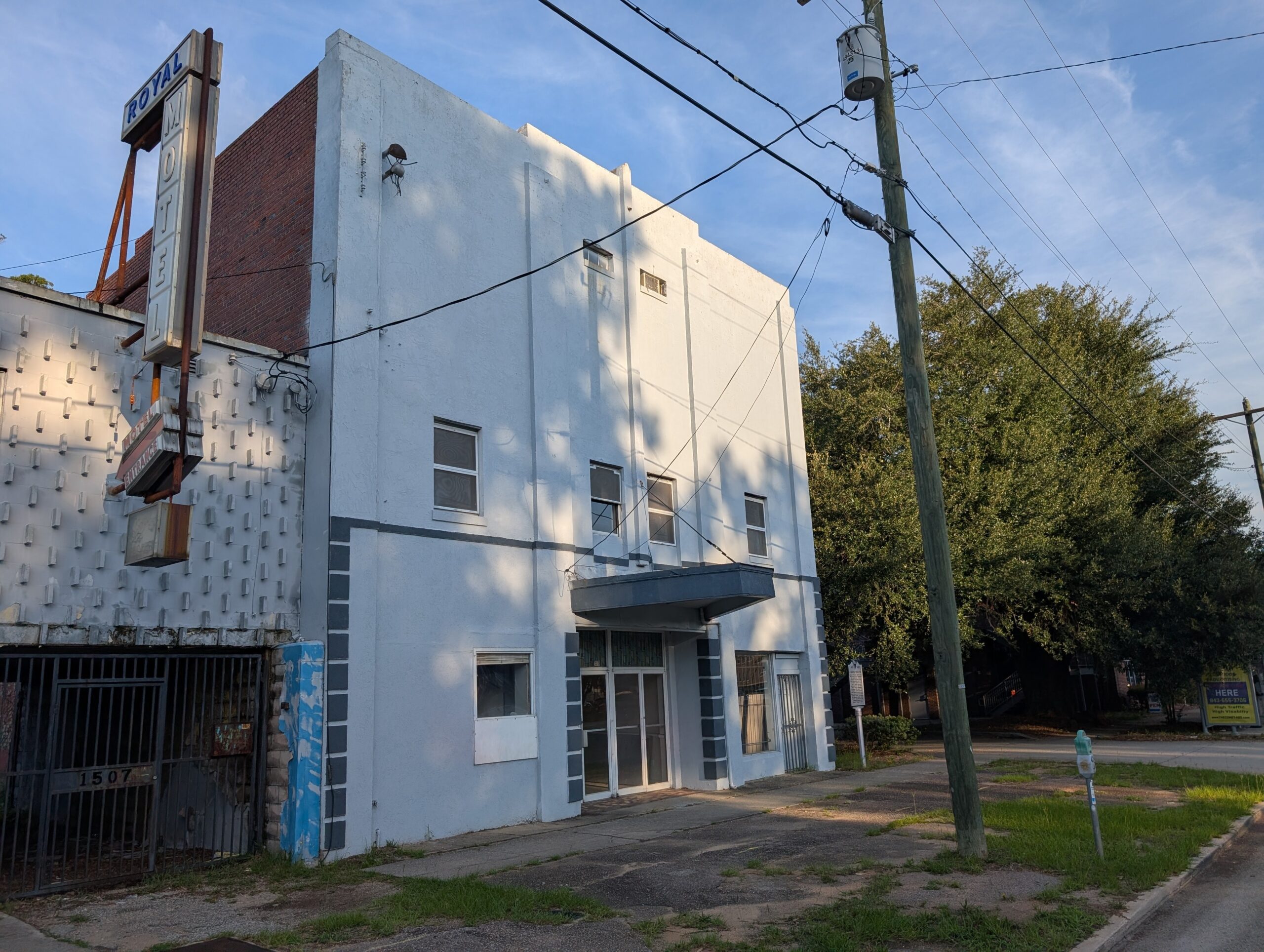
Carver Theatre ca 1941
The Carver Theatre, located at 1519 Harden Street in Columbia, is one of the city’s most important surviving landmarks associated with African American life during the era of racial segregation. Constructed about 1941, the theater was one of only two movie houses in Columbia built and operated specifically to serve the city’s African American population. With the demolition of the Capitol Theatre, the Carver became the only surviving Columbia theater purpose-built for African Americans during the Jim Crow era. Its location beside the historic Waverly neighborhood placed it at the center of one of Columbia’s most important African American residential and commercial communities.
The theater was a substantial two-story rectangular brick commercial building with a flat roof and a prominent vertical marquee projecting above the principal entrance. The brick walls were laid in five-to-one common bond, while the street façade received stucco ornamentation that gave the otherwise utilitarian structure a more polished theatrical appearance. The design, attributed to Columbia architect William P. Crosland, reflects the streamlined commercial architecture appropriate to a neighborhood cinema of the early 1940s, when movie theaters increasingly emphasized strong geometric forms, vertical signage and modern materials to attract pedestrians and motorists.
Carver Theatre emerged during a period when segregation sharply restricted the entertainment choices available to African Americans in Columbia. The theater provided a place where Black residents could attend motion pictures without the discriminatory restrictions imposed at white theaters. Its proximity to Waverly was especially important because the neighborhood contained a substantial concentration of African American professionals, educators, physicians, nurses, ministers, skilled tradesmen and business owners. The Carver thus served a community that had developed its own institutions, businesses and cultural life despite the limitations imposed by segregation.
The Carver was more than a place to watch movies. It became a significant community gathering and entertainment center, hosting weekly talent programs modeled after Harlem’s famous Amateur Hour. Young people from the surrounding neighborhood were given opportunities to sing, dance, recite poetry and display other talents. These programs helped transform the theater from a commercial movie house into an important venue for local cultural expression. The theater also presented special Saturday-morning programs for children, further strengthening its role as a neighborhood institution.
The theater’s advertising and business history provide evidence of its active operation during the 1940s and early 1950s. It appeared in Columbia city directories beginning in 1943, while advertisements for its weekly movie schedules appeared in the African American newspaper Lighthouse and Informer. Surviving business records also document advertising associated with the Carver Theatre between 1946 and 1948. These sources demonstrate that the theater was firmly established as part of Columbia’s African American commercial and cultural landscape by the early 1940s.
During most of its history, the Carver was operated by Black theater personnel but owned by the white-owned Dixie Amusement Company, a circumstance that reflected the complicated economic structure of segregated entertainment in the South. African American communities created and supported their own cultural institutions, while ownership and control of many commercial properties remained in white hands. The Carver’s history therefore illustrates both the strength of Columbia’s Black community and the economic restrictions imposed by segregation.
The interior retains important evidence of its original theater configuration despite later alterations. The first floor has been renovated and its original seating removed, but the sloping theater floor survives. Particularly significant is the balcony, where original seating and lighting remain. The lobby retains its original mosaic floor and ticket window, providing tangible evidence of the building’s use as a neighborhood cinema. These surviving features make the building especially valuable because they allow visitors to understand how the theater functioned rather than merely seeing an altered commercial shell.
The Carver continued operating as a movie theater until 1971, by which time the social and legal landscape of Columbia had changed dramatically. The end of legally enforced segregation and the integration of previously segregated entertainment facilities fundamentally altered the economic and cultural circumstances that had sustained Black-only theaters. Although the Carver ceased functioning as a cinema, the building survived, preserving an important physical connection to the decades when segregated theaters were essential institutions within African American communities.
The building was listed in the National Register of Historic Places on July 17, 2003, under Criterion A for its association with the history of Columbia’s African American community. The documented period of significance is 1941–1953, while the building’s broader history extends through its continued operation until 1971. Its National Register significance rests particularly on its role as a surviving African American movie theater and as a place where entertainment, youth activities and community life intersected during the segregation era.