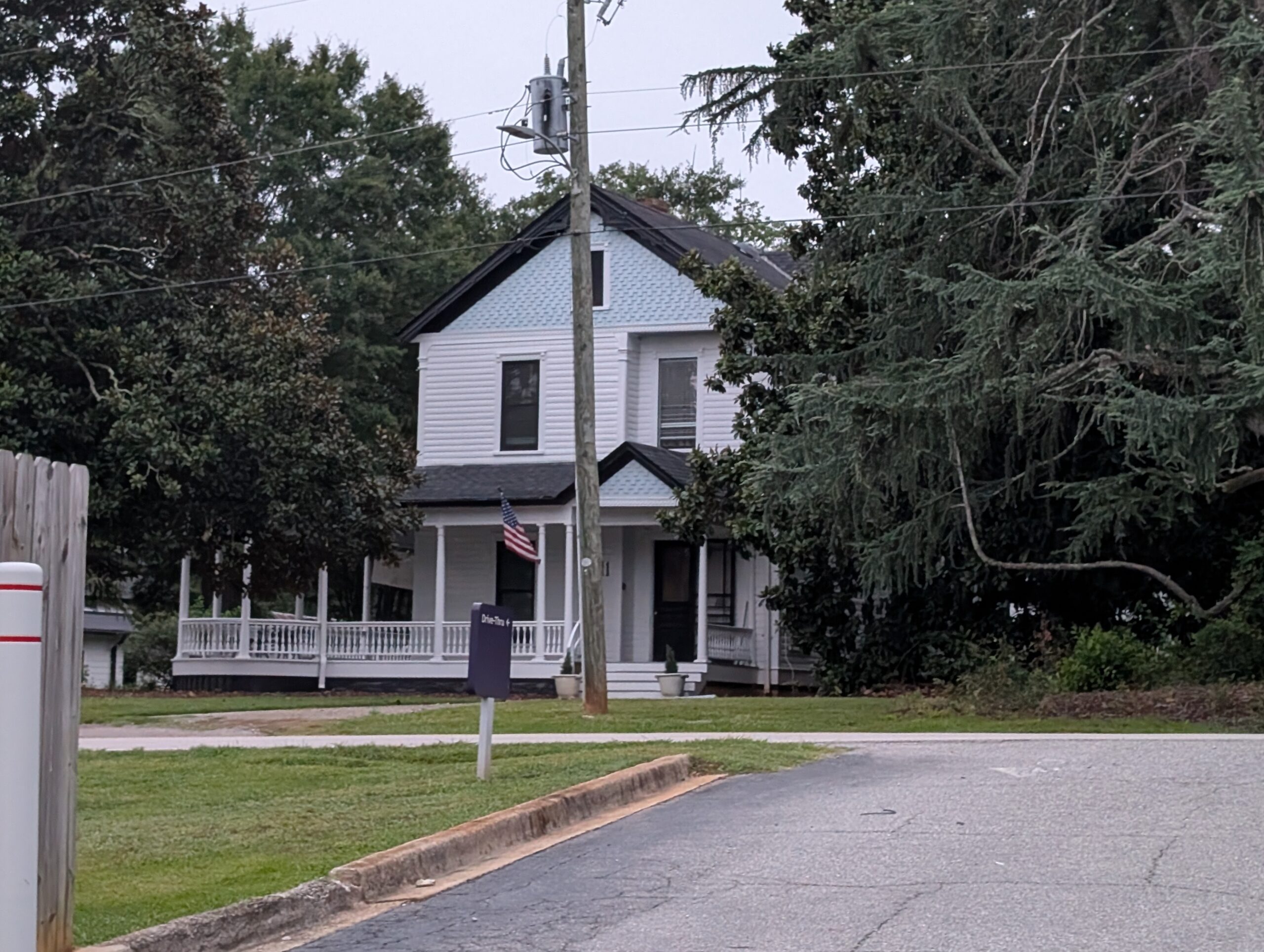
Robinson – Hiller house ca 1902 in Chapin
Constructed in 1902, the Robinson-Hiller House is one of Chapin’s most significant historic residences and an outstanding example of the Queen Anne style in Lexington County. Built for Charles Plumber Robinson (1867–1944), a prominent businessman and community leader, the house reflects the prosperity and optimism that accompanied Chapin’s growth as a railroad town during the early twentieth century. Listed in the National Register of Historic Places in 1998, the residence is recognized for its architectural importance and for its association with Robinson and his wife, Sarah “Eddie” Smithson Robinson, whose civic and social activities contributed greatly to the development of the Chapin community.
The two-story frame dwelling displays the picturesque asymmetry and decorative detailing characteristic of the Queen Anne architectural movement. Its irregular massing, steeply pitched gabled roof, projecting front bay, and prominent corner turret create a distinctive silhouette along Virginia Street. A one-story wraparound porch extends across the front and side elevations, supported by slender Tuscan columns and accented with a turned balustrade. The porch features a gabled entrance projection that emphasizes the main doorway, while brick piers with decorative lattice infill provide a sturdy foundation. A full-width one-story gabled ell extends to the rear, completing the complex arrangement typical of late Victorian domestic design. Interior features include finely crafted woodwork, substantial baseboards, original doors, and a carefully detailed entrance stairway that reflect the quality of construction available during Chapin’s early growth period.
Charles Plumber Robinson was one of Chapin’s most influential early entrepreneurs. He founded the C.P. Robinson Lumber Company, a major local enterprise that included a sawmill, lumberyard, building materials operation, and brickworks. His business interests later expanded to include a mercantile store, cotton gin, corn mill, and roller mill, making him one of the community’s largest employers during the first decade of the twentieth century. Through his industries, Robinson played a major role in transforming Chapin from a small railroad settlement into a thriving commercial center.
The home also reflects the important civic contributions of Sarah “Eddie” Smithson Robinson, who was active in community improvement efforts and served as an officer in the Woman’s Christian Temperance Union. Together, Charles and Sarah Robinson represented the leadership class that helped shape Chapin’s social, economic, and cultural life during its formative years. Their residence became a symbol of the town’s emerging prosperity and refinement.
After the Robinson family left Chapin, the house was acquired in 1919 by James Haltiwanger Hiller, a businessman associated with the Chaffin-Hiller Company, later known as the Chapin Mercantile Company. Under Hiller’s ownership, the residence continued its role as one of Chapin’s most prominent homes. Over time, the building has remained an important landmark within the community, surviving the changes brought by modernization while retaining its architectural character.
Today, the Robinson-Hiller House stands as one of Chapin’s most treasured historic resources. Its Queen Anne architecture, exceptional craftsmanship, and connection to the entrepreneurs and civic leaders who helped establish the town make it an important reminder of Chapin’s early twentieth-century heritage. The house continues to tell the story of a period when railroads, industry, and community leadership combined to shape the future of Lexington County’s lake country region.