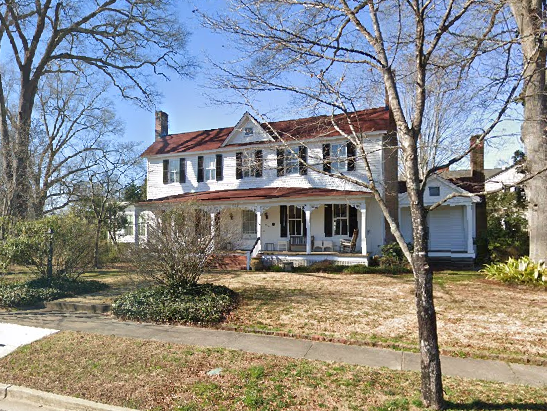
McCorkle-Fewell-Long house ca 1821
The McCorkle–Fewell–Long House stands as one of the oldest surviving residences within the city limits of Rock Hill and represents an important link to the community’s early nineteenth-century rural origins. Believed to have been constructed by local farmer Stephen McCorkle prior to 1821, the house began as a substantial two-story Piedmont farmhouse characterized by a symmetrical rectangular plan and sturdy heavy-timber framing. Over the course of its history, the dwelling evolved through a series of additions and renovations that reflected the changing tastes and prosperity of its owners.
A major remodeling campaign undertaken around 1880 transformed the house from a simple vernacular farmhouse into a more fashionable Victorian residence. Queen Anne-inspired details were added, including decorative porch ornamentation, patterned shingles, ornamental brackets, and other embellishments that softened the building’s original agricultural appearance while preserving its early structural core. The resulting blend of rural Piedmont architecture and late-Victorian design creates one of Rock Hill’s most distinctive historic homes.
The property is closely associated with several prominent York County families. Ownership passed from the McCorkles to members of the Broach, Campbell, and Fewell families before becoming connected with the Rock Hill Land and Town Site Company, whose development efforts helped shape the growth of the Oakland section of the city and supported the establishment of Winthrop College nearby. In 1906 the house was acquired by industrialist and civic leader Alexander Long, whose contributions to textile manufacturing, adult education, and community development left a lasting impact on Rock Hill and the Carolina Piedmont.
Architecturally, the house remains notable for its pegged mortise-and-tenon timber framing, full-width front porch, decorative Victorian woodwork, and surviving interior finishes. A former carriage house dating to about 1900 stands to the rear, further illustrating the property’s evolution from a rural homestead into a prominent residential estate. Today, the McCorkle–Fewell–Long House endures as a rare and tangible reminder of Rock Hill’s transition from frontier farmland to thriving railroad and industrial community.