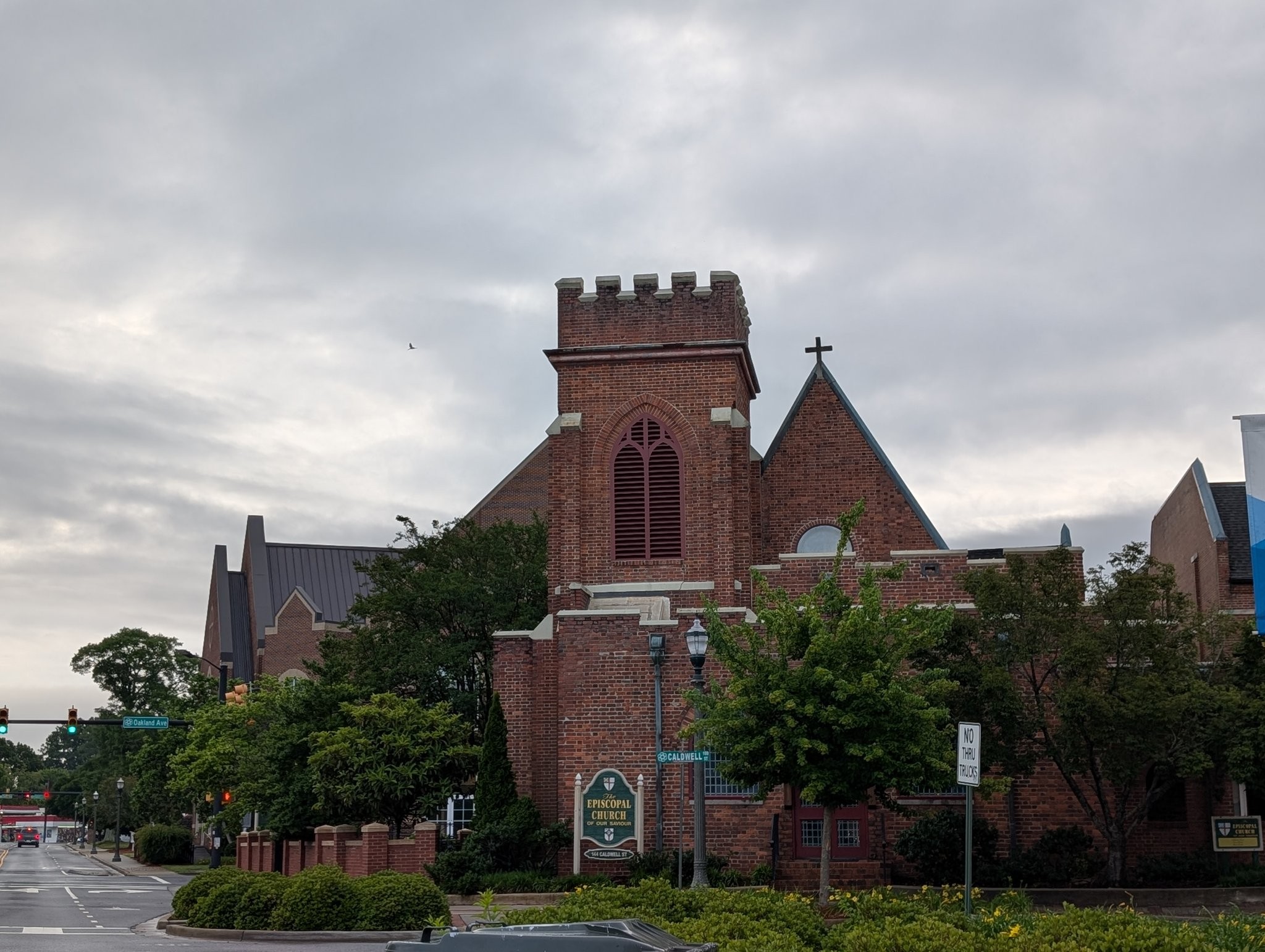
Episcopal Church of Our Savior ca 1872
The Episcopal Church of Our Savior, established around 1872, stands among the earliest organized religious congregations in Rock Hill and reflects the post–Civil War rebuilding and community formation that shaped the city’s identity in the late nineteenth century. Emerging during a period of renewed growth following the arrival of the railroad and the gradual recovery of the local economy, the church served as a spiritual anchor for one of Rock Hill’s developing congregations. Its establishment signaled both the expansion of organized religion in York County and the increasing permanence of Rock Hill as a structured and growing town.
From its earliest years, the congregation of Episcopal Church of Our Savior represented a blend of tradition and adaptation, carrying forward the liturgical heritage of the Episcopal Church while responding to the needs of a rapidly changing Southern community. Like many Episcopal congregations of the Reconstruction era, it played a dual role as both a place of worship and a center for social cohesion among families seeking stability and continuity in a period of transformation. Early church life would have reflected modest beginnings, gradually developing into a more established parish as Rock Hill expanded.
Architecturally, churches of this period in South Carolina often drew from Gothic Revival influences, even in simplified rural or small-town expressions. Such designs typically emphasized verticality, pointed arch motifs, lancet windows, and restrained but meaningful ecclesiastical ornamentation. These elements were intended to evoke a sense of reverence and historical continuity with the broader Anglican tradition. As the congregation matured, its built environment would have reflected increasing permanence, aligning with the city’s broader pattern of replacing early frame structures with more durable and stylistically refined buildings.
The growth of the Episcopal Church of Our Savior paralleled Rock Hill’s own evolution from a modest railroad community into a significant textile and commercial center by the early twentieth century. As new neighborhoods developed and civic institutions expanded, the church remained an important spiritual and cultural presence, serving generations of families who contributed to the city’s civic, educational, and economic life.
Today, the Episcopal Church of Our Savior remains a meaningful link to Rock Hill’s Reconstruction-era heritage and early community development. Through its longstanding presence and continued role in the spiritual life of the city, it offers insight into the religious foundations, architectural traditions, and communal values that helped shape Rock Hill during one of its most formative historical periods.