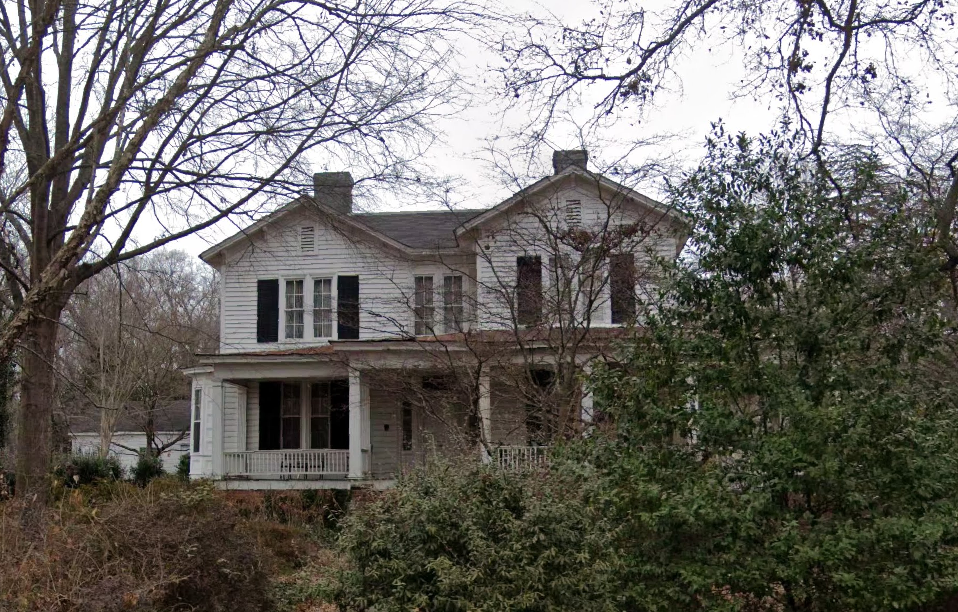
Banks -Mack House ca 1871 in Fort Mill
The Banks-Mack House, constructed circa 1871 in Fort Mill, is among the town’s most historically significant and architecturally distinctive residences. Located along Confederate Street within Fort Mill’s historic residential district, the house reflects both the early growth of the community following the Civil War and the prosperity brought by the rise of the textile industry in York County. Originally built by W. H. Stewart, a contractor associated with the construction of the first building for the Fort Mill Manufacturing Company and a former member of the South Carolina House of Representatives, the residence became closely tied to several influential Fort Mill families whose leadership shaped the town’s civic, educational, and religious development.
Originally a modest late nineteenth-century dwelling, the house underwent a major enlargement and renovation in 1910 under the ownership of Hattie Banks Mack and her husband, Reverend J. B. Mack. During this renovation, the structure acquired many of the Classical Revival features that define its present appearance, including its symmetrical façade, broad wraparound porch, prominent columns, and balanced proportions. The resulting design embodied the elegance and refinement popular during the early twentieth century while preserving elements of the home’s earlier historic fabric. The expansive porch became especially well known because it was constructed around a large hickory tree that Mrs. Mack insisted be preserved, creating one of Fort Mill’s most memorable local landmarks for decades.
The house also holds significance through its association with prominent members of the Banks and Mack families. Reverend William Banks, pastor of Unity Presbyterian Church, and later Alexander R. Banks, educator and first superintendent of the Rock Hill public school system, were connected to the residence. Reverend Joseph B. Mack and members of the Banks family were also early investors in the Fort Mill Manufacturing Company, linking the property directly to the industrial and economic transformation of Fort Mill during the late nineteenth century.
Listed in the National Register of Historic Places in 1992, the Banks-Mack House remains an outstanding example of Classical Revival residential architecture and an enduring symbol of Fort Mill’s cultural and economic heritage. Its architectural character, prominent historical associations, and longstanding presence within the community continue to illustrate the town’s evolution from a small postwar village into one of the region’s most prosperous textile centers.